Irish National Organisation of the Unemployed
INTRODUCTION
The Irish National Organisation of the Unemployed (INOU) welcomes the opportunity to
make a submission to the Independent COVID-19 Evaluation Public Consultation. This
submission will focus on three of the structures / headings used in the public survey run
earlier in the summer: work and financial security; education and development;
relationships, social connections and community.
“The INOU is a federation of unemployed people, unemployed centres, unemployed
groups, community organisations and Trade Unions. The INOU represents and defends
the rights and interests of those who want decent employment and cannot obtain it. We
promote and campaign for policies to achieve full employment for all. We also
campaign for an acceptable standard of living for unemployed people and their
dependents. The INOU is an anti-sectarian, anti-racist, non-party political organisation
which promotes equality of opportunity within society.” (INOU Mission Statement).
The organisation has a hundred and ninety-six affiliated organisations and eight
hundred and seventy-eight individual members. We work at a local and national level
on issues affecting unemployed people and others reliant on a social welfare payment.
We provide a range of training for people who are unemployed and organisations
working with people distanced from the labour market; we provide a welfare rights
information service, primarily by telephone, by participating at in-person events; we
analyse and discuss with our membership relevant Government policies; undertake
advocacy work; and work with a wide range of other organisations on issues of common
concern.
CONTEXT
COVID-19 Labour Market Statistics
On April 1st 2020, the Central Statistics Office (CSO) published an Information Note on
how they would deal with the statistical challenges COVID-19 pandemic generated with
regard to the production of the Monthly Unemployment (MU) and Live Register figures.
The Monthly Unemployment (MU) figures were presented with and without the impact
of COVID-19. A key reason for this approach relates to how unemployment is
measured. An International Labour Organisation (ILO) definition is used which allows
figures to be compared across time and countries. Basically, to be counted as
unemployed a person must be actively seeking work over the previous four weeks and
be available to take up work over the coming two weeks.
The scale and speed at which Ireland’s labour market was turned on its head was
unprecedented. The measures rolled out to help people who had lost their jobs were
introduced on an assumption that the labour market impact would be short term,
which was not the case. Though contrary to expectations at the time employment not
only bounced back, it grew to historic highs in the post-Covid period.
In early April 2020 it was not possible to ascertain how many people on the COVID-19
Pandemic Unemployment Payment (PUP) would meet the ILO definition of
unemployment. The CSO present figures as if everyone on PUP would, and this resulted
in the seasonally unadjusted unemployment rate going from 5.2% to 16.5%. The impact
on the female unemployment rate was greater, it rose from 5.2% to 17.8%, while the
male unemployment rate increased from 5.3% to 15.4%. In such a scenario the Monthly
Unemployment Rate for people aged 15-24 years increased from 12.3% to 34%, while
the unemployment rate for people aged 25-74 increased from 4.2% to 14.1%. These
adjustments illustrate the gender and age impact of COVID-19, reflecting that the
sectors badly hit by the lockdowns had a younger and higher female profile.
From March 2020 to June 2022, in their Live Register releases, the Central Statistics
Office reported on the following data, though by June 2022 only the Live Register itself
contained data:
- The Live Register Total;
- The Seasonally adjusted Live Register Total;
- Number of claimants of the Pandemic Unemployment Payment;
- Number of claimants on the Revenue Temporary COVID-19 Wage Subsidy
Scheme (TWSS), which was replaced with the Employment Wage Subsidy
Scheme (EWSS) on September 1st, 2020; - Total of the Live Register plus claimants of the two foregoing COVID-19 related
payments.
Table One illustrates how four of these figures changed over this time period:
TABLE ONE: KEY STATISTICS DURING COVID-19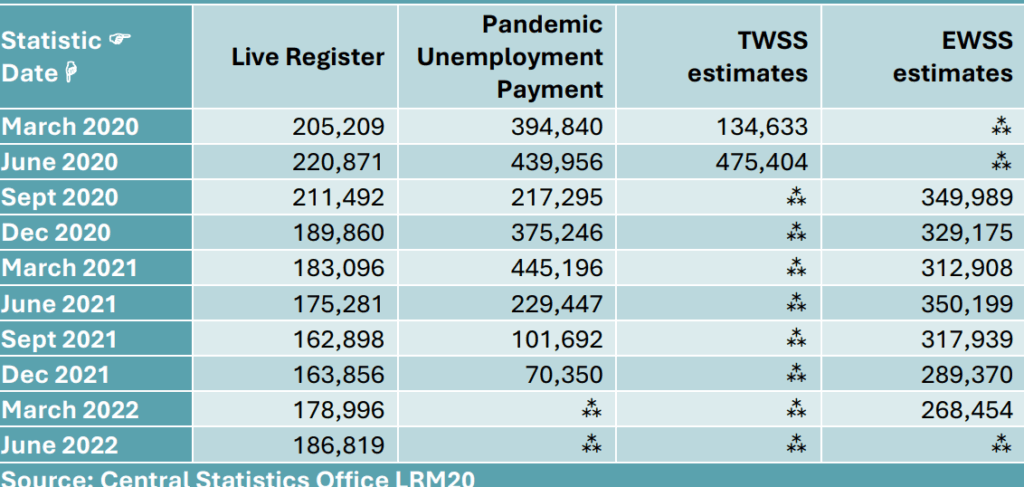
Source: Central Statistics Office LRM20
The Department of Social Protection’s Annual Statistical Report 2024 in Table D2,
which shows the ‘Number of Recipients and Beneficiaries of Main Working-Age Income
Support Benefits by Type, 2015–2024’, that there were 328,526 recipients /
beneficiaries of the COVID-19 Pandemic Unemployment Payment in 2020 and 67,581
in 2021. (p36)
Later on, in Table I2, which captures the ‘Claims Registered by Year and Benefit, 2019–
2024’, that in 2020 1,412,718 people registered a claim, this fell to 376,534 people in
2021 and 31,726 in 2022. (p81)
Wider Labour Market Statistics
Table Two contains Labour Force Survey (LFS) data using the official / ILO definitions of
employment and unemployment, the Potential Additional Labour Force and the
Principal Economic Status. This LFS data comes from Quarter 2 in each year from 2019
to 2025. In 2019 no-one was aware of the serious health pandemic that would hit
Ireland in early 2020. While in 2025 many people deem COVID-19 as in their past,
though for some people and sectors it remains an on-going health challenge.
As noted earlier to be classified as unemployed a person must answer yes to two
questions: actively seeking and available. The Potential Additional Labour Force (PALF)
statistic was developed to capture people who answer one or both questions
negatively, but who would be seeking employment if circumstances changed. The
Principal Economic Status (PES) captures how people describe / define themselves, be
it at work, unemployed, retired from employment, engaged on home duties, a student,
unable to work due to permanent sickness or a disability, or other.
In the Government’s Economic Recovery Plan, published in June 2021, they stated that
“Our ambition is to have 2.5 million people in work by 2024, exceeding pre-pandemic
levels.” They went on to say that “The government’s labour market approach is about
providing opportunities to reskill and upskill, minimising long-term unemployment, and
supporting individuals to secure sustainable and quality employment.”’ As the Table
Two demonstrates this ambition was exceeded well before 2024, while the most recent
figure shows historically high levels of employment.
However, the picture for unemployment is more mixed. The Unemployed column
follows the ILO’s definition of unemployment, and in this year the numbers of people
who are unemployed is higher than the pre-Covid 19 figure. Interestingly the Potential
Additional Labour Force (PALF) and the Principle Economic Figures (PES) in Q2 2025 are
lower than the same quarter in 2019. In 2020 and 2021 both of these figures were
considerably higher and possibly captured some of the COVID-19 impact on the labour
market.
TABLE TWO LABOUR FORCE SURVEY QUARTER 2 2019 – 2025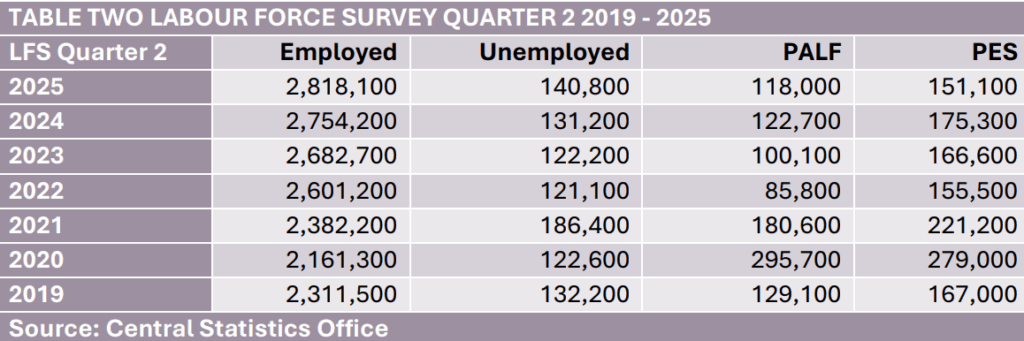
WORK AND FINANCIAL SECURITY
On the day the first case of COVID-19 was flagged in Ireland, as part of our Decent Work
project, the INOU ran a workshop in the EDIC in Longford. At the time we had little
appreciation that running the final event for this project would happen online, a
prospect we would not have even contemplated when planning this piece of work. In
the meantime, we have become very adept and familiar with running online events.
As the scale of the health crisis facing the country became apparent, the INOU found
itself like so many other organisations having to close up our place of work and
establish ourselves in our kitchens, spare rooms, bedrooms, wherever it was feasible to
work from, and try to carry on with our work. An upgrade of our IT system and hardware
was required to ensure we could function.
In the early days of the pandemic information was changing on a daily basis, there was
a lot of confusion, and the information on our website was updated regularly. People
were contacting us to ascertain what would happen to their Working Family Payment if
their employment was stopped.
In early April we were informing people of what to do if they were unable to get to the
Post Office to collect their Jobseeker’s payment. The Department of Social Protection
(DSP)1 introduced a measure that allowed people to receive two weeks money in one
payment, which some people found very helpful, while for others it threw up some
additional money management challenges. The DSP also facilitated money to be
maintained by the recipient’s Post Office for up to 90 days and re-introduced
Jobseeker’s payments being paid into recipients’ bank accounts, which had been the
arrangement before the 2008 financial crisis hit.
As Intreo Offices themselves moved to only opening on a part-time basis signing-on
requirements were lifted, activation and penalty measures were also put on hold. The
Fuel Allowance was extended by four weeks; and the payment paid for a Qualified Adult
(QA) on a Jobseeker’s payment was increased by €13 to bring the Claimant and QA
payment up to the initial and highest level of the PUP: €350.
Pandemic Unemployment Payment
In response to the COVID-19 pandemic the Government introduced the Pandemic
Unemployment Payment (PUP). The purpose of PUP was to make available to
employees and self-employed people who have become unemployed a flat rate
payment of €350 per week for the duration of the pandemic emergency. There was no
restriction on people aged between 18 and 66 years applying for PUP provided they
have been in employment up to March 13th 2020, and this employment has since
ceased. Anyone who was working part-time and claiming a Jobseeker’s payment either
casually or on systematic short-time basis could only claim the PUP if they had
become fully unemployed.
In the initial phase of the pandemic the Department of Social Protection (DSP) was known as
Department of Employment Affairs and Social Protection (DEASP), throughout this submission the
current name will be used.
Initially people could apply for the payment through a written application form, either
downloaded from the Department’s website page on gov.ie or through requesting a
form by post or through dropping into their local Intreo Office. However, given the scal
and impact of the crisis the DSP asked people to apply on-line through My Welfare.ie.
As there were no back payments for the Pandemic Unemployment Payment, it was
important for people to apply as soon as possible. In the early days of the pandemic, it
was envisaged that an applicant would be paid for up to 12 weeks from the week the
claim was processed and awarded.
In response to queries raised with the INOU, the DSP confirmed that an applicant did
not need a Public Services Card (PSC) to claim the PUP. The requirement to have a PSC
was temporarily suspended for Jobseeker payment claims as well. The Department
also established the COVID-19 Income Support Help line (1890 800024) to assist
people with any difficulties with their PUP application.
The Pandemic Unemployment Payment (PUP) was a flat rate payment of €350. So, if the
person applying was claiming only for themselves, they were better off on PUP, as the
maximum they could receive on a Jobseeker’s payment at the time was €203. However,
if the person could also claim for an adult and child dependents, known as Qualified
Adult and Qualified Child Increases, they may well have been better off on a regular
Jobseeker’s payment. Ireland’s social protection system is complex and applicants
needed to weigh up what they would gain or lose on the different options. So, if the
person was in receipt of a Working Family Payment (WFP) they were more than likely
better off on PUP, as they could maintain their WFP, but they would lose it if they moved
onto a Jobseeker’s payment.
In response to queries raised by the INOU, the Department confirmed that a Qualified
Adult who had lost their work and was now fully unemployed could apply for PUP in
their own right. At the time the DSP noted that the Qualified Adult should also make a
Jobseeker’s application in their own right so, if applicable, their partner’s claim can be
adjusted. Given the volume of applications being processed at the time, they also noted
that if any adjustments or amendments needed to be made, these would happen at a
later date.
No new supports were introduced for employees whose employment was reduced to
part-time or casual working because of the impact of COVID-19. The existing supports
were the Short Time Work Support Scheme (STWS); or a Jobseeker’s Allowance (JA) if
they do not meet the eligibility criteria for STWS. STWS was available to all employees
who were put on short time working week on a temporary basis due to a reduction in
their employers’ business. To qualify applicants had to meet all of the qualifying
conditions of a Jobseeker’s Benefit payment at the time; be working for 3 days per week
or less; and have been previously employed on a full-time basis.
How PUP changed over time
Given the scale of the health crisis Ireland faced, a more straight forward and less
complex application process for a Pandemic Unemployment Payment was introduced
in comparison to the Jobseeker’s payment process. As a result a greater number of
people were able to access it, in particular young people who may not have built up an
entitlement to Jobseeker’s Benefit (insufficient PRSI contributions); or if they lived at
home, their parents’ income would have been taken into account if they had applied for
a Jobseeker’s Allowance payment, which is means-tested; or if they were full-tim
students who had lost part-time work. This effective individualisation of the payment
also meant for couples, each person was treated as a claimant in their own right, and
the income or circumstances of their partner were not taken into account, while it is
when a person makes a claim for a Jobseeker’s payment.
PUP moved from the equivalent of a full working age payment (€203) to the equivalent
of a full claim plus a Qualified Adult payment rounded up to the nearest fifty (€350).
Then the payment levels were adjusted to reflect what a person earned previously and
for a while there were four levels to the payment: €203; €250; €300; €350. This reflected
the position with a Jobseeker’s Benefit (JB) payment, though the amounts payable on JB
were considerably lower at the time: €91.10; €131.00; €159; and €203.
As noted earlier, in June 2021, the Government published the Economic Recovery Plan.
Amongst the changes announced was an alignment of the PUP with the Jobseeker’s
payments over a six-month period from September 2021 until February 2022. As the
country adapted to the on-going impact of the COVID-19 pandemic, the timescale set
out in June was changed, though the payment for full-time students ended at the start
of the 2021/2022 academic year in early September.
On the Department of Social Protection’s website, they noted that “The process of
moving from the lower €203 rate of PUP to a jobseeker’s payment was due to begin in
early September. This has been deferred until after all sectors have started to re-open in
line with the Roadmap announced on 31st August and all affected customers will
continue to receive their PUP payment until 26th October when the process of their
transition to a Jobseeker’s payment will begin.”
It is important to note that this transition would not have been automatic. Anyone on
the lowest level of the PUP in mid-October expecting to receive a Jobseeker’s payment
by the end of the month, should have applied for that payment by October 21st, 2021.
The Department stated that anyone in this position who had not applied to them for a
Jobseeker’s, or more appropriate working age, payment would not receive a PUP after
October 26th, 2021. This process would occur two more times: on November 16th 2021,
and February 8th, 2022.
Varying impact
In their report Pandemic Unemployment and Social Disadvantage in Ireland, the
Economic and Social Research Institute (ESRI) noted that “There is a growing literature
on the relationship between area-level deprivation and the impacts of the COVID-19
pandemic. The vast majority of literature to date examines the health impacts of the
pandemic where infections rates and severe illness in the form of hospitalisations and
ICU admissions have been found to be higher amongst residents of more deprived
areas”. (p35) This report, Research Series No163, published in July 2023 examined “the
economic impacts of the pandemic by examining the relationship between pandemic
unemployment and deprivation due to COVID-19”.
The “results show that deprived areas – when compared to the most affluent areas –
were also more affected economically by the pandemic, and deprived areas
experienced the economic impact in a more volatile manner. Individuals in deprived
areas, even after controlling for area-level occupational composition, were more likely
to see more extreme changes in pandemic-related unemployment based on changes
due to Government restrictions.”
The ESRI also noted that “The sharp fall in PUP rates in deprived areas following the
easing of restrictions, coupled with the shorter average duration of PUP receipt in
deprived areas, could also indicate that employees in these areas had less discretion
when it came to returning to work.” (p37)
IHREC published a report prepared by the ESRI in 2024 titled “The Equality Impact of the
Covid-19 Pandemic on the Irish Labour Market”. In this report the authors note that
“Education differences have widened somewhat in terms of the nature of work. Remote
work is much more common among those with a third-level degree, around half of
whom work from home in 2022 (see Table 4.2) compared to 12 per cent of the lower
educated. The gap in usual hours worked between these two groups also widened
during the period. Combined with suggestive evidence that inactivity for the lower
educated rose during the period, this suggests that this group may have been
disproportionately negatively affected by the pandemic – both in terms of labour market
participation and the nature of work – compared to more educated groups.” (p68-69)
EDUCATION AND DEVELOPMENT
In Issue 41 of the INOU’s e-bulletin, published in April 2020, we noted that “both of the
INOU’s Local Training Initiatives (LTI), Building Futures and Shaping Futures,
coordinators and external tutors have been working extremely hard on developing two
online platforms to ensure that all the learners are able to continue with their learning,
with as little disruption as possible.”
In the next issue readers heard from four learners what it like to learn online. As one
learner noted “First, I went into panic mode, asking myself ‘How will I manage without
my own PC or tablet?’ The library where I always went to do my assignments was
closed. It wasn’t financially possible for me to buy a computer, but with the help of the
INOU team, my colleagues and I were able to borrow laptops for the COVID-19
lockdown.”
The impact of moving from a physical learning space to a virtual one is captured in the
following quote: “We had spent months in a classroom setting with the comfort of the
trainer in our presence where we could ask questions about things we were unsure of.
Then the COVID-19 pandemic hit and we were confined at home, uncertain of what was
going to happen with our course.” Another participation noted that “I’m the type that
has to have a good understanding of a task before I make an attempt so I tend to ask a
lot of questions, but, with our circumstances, I became frustrated at times because I
felt like a nuisance having to constantly ask our trainers questions over the phone. Also,
with the constant flow of emails, WhatsApp messages and Zoom meetings coming in, I
became very overwhelmed and at times I thought ‘How am I going to manage this?’”
On the positive side a learner stated that “(…) many things in addition to the whole
learning package have made online learning easy to follow, and a great way to carry out
assignments: regular learning group Zoom calls with the tutor for each module where
we learn, ask questions and share our own work; using Google Docs for group
assignments which was a new and enjoyable experience for me; and a WhatsApp group
connection where the participants can support each other and contact the tutors at any
time during the day.”
Another noted that “When I look back over the experience, I think I learned a lot more
than I would have in a classroom due to the fact that I examined my tasks much more
thoroughly as they were sent to me. I found myself really focused on the tasks – maybe
because I knew that I did not have the comfort of asking the trainer for help in
person. (…) It was difficult, but I really enjoyed the challenge.”
One of the issues that arose was the challenges facing people whose living conditions
were not conducive to online learning. For example, living with many other people and
unable to find a space to listen and interact with an online class, or not having a good
enough internet connection. Feedback the INOU received through other areas of our
work highlighted the limitations of using mobile phones, and the need for organisations
providing education, training and learning opportunities to be able to support
participants to acquire the necessary equipment and know how to use it effectively. The
development of funding lines like the MAED (Mitigating Against Educational
Disadvantage) and other supports were welcome to help address some of the
challenges facing less advantaged adult learners.
In Issue 47 of the INOU e-bulletin, September 2021, we noted that the INOU had moved
our training online – similar to so many other organisations that organised and ran
training and events. In response to the positive feedback this work has been developed
and maintained since, it facilitates a greater number of people to participate in these
events, even though we all miss the in-person interaction and opportunity to follow-up
on matters of common interest at the coffee break.
At this time, we started developing short, targeted ‘deep dives’ into specific topics
which consisted of a mix of presentation and discussion. A broad range of topics have
been covered since including disability payments; Back to Education Allowance;
decision making process for different payments, reviews and appeals; welfare to work;
and annual budgetary changes.
RELATIONSHIPS, SOCIAL CONNECTIONS AND COMMUNITY
The less complex application process for the Pandemic Unemployment Payment (PUP)
was a welcome development, once the system moved online to mywelfare.ie it was
relatively straightforward for applicants to receive their payment. It is unlikely that the
existing social welfare system would have coped with the sudden and dramatic drop in
employment. For the majority of applicants once their entitlement to a PUP was
established it was paid into their bank account the next available payment date,
recipients did not have to queue to receive their payment, which has been the case with
Jobseeker’s payments. Many people were struck by the impact of the emergency on
prioritisation and delivery, and the significant and prompt changes undertaken by
Government.
However, concerns have been raised with the INOU about the long-term impact on
labour market engagement of COVID-19. Notwithstanding the historically high
employment figures, at INOU events attendees have raised concerns about how
isolated some unemployed people are, how key social skills, so vital in most
employment settings, suffered under the impact of the pandemic lockdowns,
exacerbated in some areas by a local of affordable, accessible and regular transport.
People being able to work from home, to work remotely, meant that for a lot of
businesses and organisations, including the INOU, people were able to maintain their
income and organisations were able to maintain and develop their work. As noted
under the education heading inequitable access to IT – digital equipment and / or
reliable internet – impacted on how well some people could work from home. As one
member of the INOU’s National Executive Committee noted “circumstances govern
everything”. Complicated or cramped living arrangements, a number of people trying to
work and study in the one household had an impact on people’s mental health, wellbeing
and relationships. For some young people the start to their ‘adult’ working life
commenced in their bedrooms, engagement with their work colleagues was online,
and the opportunity to pick up additional and helpful work information informally
was not available to them.
Before COVID-19 online meetings were rare, they became ubiquitous during the
pandemic, some people found them very useful in maintaining contacts, developing
work and relationships. Other people missed the human contact, the informal chats
that take place at in-person events, which can be so critical to information exchange,
building contacts and exploring new ways of working collaboratively.
As noted in the previous section, the INOU has moved most of our events online, this
move has facilitated a greater number of events, on a wider range of themes, and run in
conjunction with more organisations from the community, voluntary, local
development, public, academic or business sectors. A greater number of people are
able to attend, as there is no commute the time required is just the length of the event
itself. The feedback on these events is very positive and people appreciate the
opportunity to hear and enquire about a range of topics, and how it resonates with their
own work. These online events have covered, for example Cross Border with Advice NI
and North Connacht and Ulster MABS; Employment Rights with Coolock Law and
Mediation; Employment Guidance and a Creating an Eco Social Welfare with Maynooth
University; Literacy Resources with NALA and Kilkenny/ Carlow ETB; ALL Innovation and
Collaborative Fund with ALL; JobsIreland.ie with the DSP; Pobal’s Deprivation Index;
SOLAS; and Public Libraries.
IN CONCLUSION
COVID-19 impacted on people’s ability to work and engage in education and training.
Access to the Pandemic Unemployment Payment, at a higher level of payment, and
with simplified administrative system to access this support was an important
development. Highlighting the importance of the State responding appropriately at a
time of crisis.
Being able to work from home was helpful for many people, though this required a level
of technical support not every person or organisation had, some were able to adapt,
others struggled. This was particularly important for people engaging in adult and
community education and training. Another complication for people was their
accommodation arrangements, this did not always facilitate working and / or learning
from home, while public spaces were not accessible, particularly during the higher /
tighter lockdowns. The digital divide in Irish society became very apparent during the
pandemic.
COVID-19 introduced hybrid working as the norm, and this threw up challenges around
organisational communication: informal dynamics, that can be so important in
developing and maintaining organisational knowledge, are hard to develop and
maintain online. However, being able to meet up with people within an organisation and
from others online was helpful in maintaining, continuing and developing work and
associated relationships.
It will be interesting to see overtime what will be the longer-term impact of the COVID19
pandemic: do we now live in a truly hybrid world? Will it be possible to distinguish it
from the cost-of-living crisis that followed on from this health pandemic? In July 2025
the Central Statistics Office noted that the Consumer Price Index (CPI) had increased
by 1.7%, considerably lower than July 2022 (9.1%), July 2023 (5.8%) and 0.5 percentage
points lower than July 2024 (2.2%). However, it is important to look at the CPI itself. In
July 2020 it stood at 84.1, it increased to 85.9 in July 2021. In the subsequent years it
increased to 93.8 (July 2022), 99.3 (July 2023), 101.5 (July 2024) and 103.2 (July 2025), a
22.7% increase over the period. This reality is having a significant impact on many
people’s health and well-being. In the document for the National Economic Dialogue
2025, in Appendix 1: “Well-being” – How is Ireland performing? It notes that “This year’s
data show that single-parent households, younger people in the workforce,
unemployed people, people in bad or very bad health, households with lower incomes,
and households in accommodation rented at market rates are population cohorts with
lower well-being outcomes than other comparable groups across multiple well-being
dimensions.” (p11)
Footnotes
1 In the initial phase of the pandemic the Department of Social Protection (DSP) was
known as Department of Employment Affairs and Social Protection (DEASP),
throughout this submission the current name will be used.