
Clean Air Advocacy Ireland
Submission to independent COVID-19 Evaluation
Clean Air Advocacy Ireland is grateful for the opportunity to submit comments and observations as a stakeholder organisation to the Independent COVID-19 Evaluation for the defined period of 2020-2022.
Our organisation did not exist before the emergence of SARS-CoV-2 and was only formed in the aftermath of the Public Health Emergency of International Concern officially ending on May 5th 2023. We believe the issue of Indoor Air Quality warrants continued and urgent attention.
To quote Dr Hans Henri P. Kluge, Regional Director for WHO/Europe, “While the international public health emergency may have ended, the pandemic certainly has not… And as our Region seeks to emerge from this crisis, it is also faced with new health threats, at a time when our health systems face increasing workforce and other challenges.”
“Using the momentum built since 2020, now is the time to invest and sustain the gains made during the pandemic response and apply the lessons of this pandemic and other health emergencies… This is the way to increase the resilience of our health systems against future shocks.”1
Government and Public Health Response
Much has been made in recent years of whether or not lockdowns should have happened, or if schools should have been shut down, or loved ones isolated from their dying relatives. We wish to acknowledge at the outset that the initial onset of the Pandemic as it emerged in January 2020 was a truly unprecedented experience for everyone, be they in positions of power, or average citizens looking for information and reassurance from authority figures. It should also be remembered that the WHO only declared a global Pandemic on 11th March 2020, only 1 month after a General Election2 took place in Ireland and from which no Government had yet emerged.
Brexit negotiations were ongoing3 and the Northern Ireland Executive had only just been restored in January 2020 after 3 years of suspension.4
The timing of Covid-19 arriving could not have been worse in terms of having the power structures in place to handle the situation confidently and swiftly.
We don’t know how much information Government and Public Health authorities had in the first quarter of 2020. However, given the scale of severe illness and death that was emerging from Wuhan due to SARS-CoV-2 by early February5 and Ireland’s status as one of the most highly globalised economies in the world, we should have recognised our vulnerability to importing the virus and put mitigation measures in place sooner than mid-March 2020.
In hindsight and at the time, the decision to delay introducing mitigations and closures appears to have been economically and politically motivated, not wanting to miss out on the economic and global networking opportunities St. Patrick’s Day provides.6 The international travel to and from Ireland during this period was a major driver of infection. Irish participation in Cheltenham in March 2020 had a major impact on seeding the virus amongst the Irish population7. In the end, St. Patrick’s Day festivities were cancelled8 but not before COVID-19 was given plenty of time to enter the country.
Overview of Irish Government response to Sars-CoV-2
If SARS-CoV-2 had been a virus that negatively impacted livestock, based on historical accounts much stricter mitigations would likely have been introduced sooner than what transpired in 2020. Foot and Mouth Disease may now feel like a lifetime ago, and those of us who were alive at the time may only remember having to step onto disinfectant mats on entering certain premises.
For the purposes of this evaluation, it is worth reflecting on just how seriously Foot and Mouth disease was taken by the government of the day; a disease that greatly threatened the health of livestock and the economy of Ireland, but thankfully, did not affect human health in any way.
Taoiseach Bertie Ahern acted swiftly and decisively, announcing, as reported on the Dáil record on 2 March 20019, that he was placing “more than 750 gardaí on Border duty” and “almost 200 gardaí” to work at ports and airports in addition to the 200 army personnel who had already moved to the Border. This action was taken before any case of the disease had even been detected in the Republic of Ireland. This was deemed to be a proportionate response to the threat of an epizootic outbreak. Of the approximately 208 official road crossings, 141 roads along the Northern Irish border were policed to effectively monitor border crossings.
Failure to Close Borders
In the early period of the COVID-19 Pandemic 2020-2022, TD’s and Ministers continued to cite the Good Friday Agreement and Common Travel Area as a reason why we could not control our borders to pursue a “zero covid” strategy within the context of a highly infectious and mutating virus, spreading around the globe.10
Taoiseach Micheal Martin in October 2020 said “Taking a zero-Covid approach is ‘not credible’ as it would be impossible to seal the border.”
“Our geographical location, in my view, makes zero-Covid not credible and very difficult to implement.”11
It should be noted that the date the emergency measures were taken by Taoiseach Bertie Ahern in March 2001 in response to Foot and Mouth Disease was just three years after the Good Friday Agreement had been signed.
While it should have been possible to achieve an all-island response to controlling the spread of the virus – and this really needs to be examined and worked out for future pandemic preparedness – in failing that, we had free movement from a neighbouring jurisdiction taking a “herd immunity”12 approach to the pandemic which no doubt impacted case count and mortality.13
While the borders remained open throughout the Pandemic, residents of Ireland endured strict lockdowns which at times confined people to within 2km and 5km of their homes.14 This was quite a glaring discrepancy15, but the people of Ireland took it in their stride for the common good. It is questionable whether the public response would be so accepting of such double standard in the future.
The Airborne nature of SARS-CoV-2
The biggest discovery from the Covid-19 pandemic is that SARS-CoV-2 and most colds, influenza, and other respiratory illnesses, are spread via bio-aerosols that hang in the air like smoke and are not only droplet-spread.16
Thanks to world renowned aerosol scientists spearheaded by Professor Lidia Morawska, Professor Yuguo Li and Dr. Linsey Marr, we now know that many pathogens are in fact spread through the air we breathe via aerosols smaller than 100 microns. These aerosols can linger for hours in an empty room, especially if there is poor ventilation in place.17
Emergence of new chronic illness and post-viral sequelae
By October 2020, the Health Service Executive through the National Health Library and Knowledge Service compiled evidence about the existence of long-COVID or post-COVID and its persistence for COVID-19 survivors.18
This document made note that it was “speculated that the virus may injure multiple organs and/or bodily systems. Potential long-term effects include damage to lungs, the immune system, the heart, and the brain, resulting in neurological complications, olfactory dysfunction and/or chronic fatigue similar to CFS/ME. There is potential for a significant and persistent negative mental health impact, based on previous experience with other pandemics.”19 All of this has since been proven correct, with hundreds of thousands of research papers now documenting the different ways Covid-19 harms our bodies and our health with just one, or multiple infections.20
Despite this being the up-to-date public health knowledge that existed in Autumn 2020, schools continued to reopen after approximately 2-3 months of school closures21 on the premise that “children seem generally less likely to catch infection” according to HSE guidance.22 Schools continued to stay open, with the mantra “schools are safe”23 repeated ad nauseum by public officials in the media as more and more children became ill.
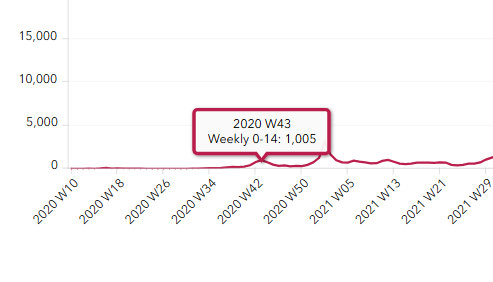
Source: hpsc.ie24
In a briefing from the Department of An Taoiseach, it was stated that “To date the public health evidence shows that schools are safe places and that the risk of COVID-19 has been managed very well within the school environment.”25 This was in December 2020 when schools were experiencing outbreaks and clearly driving up community case numbers as the rest of the country had been in level 5 lockdown until 1st December.
The idea that schools would reopen on the basis that “children seem generally less likely to catch infection” after they had been in lockdown for months, with little chance of being exposed to the virus, was absurd in September 2020.
It was negligent of the Government to sign off on the reopening of schools with no solid evidence that children were not negatively impacted by Covid-19 and without dealing with the reality of poor ventilation in schools and classrooms or the fact that SARS-CoV-2 is transmitted through the air as was being published and discussed in science and public health circles since early summer 2020. Instead, the focus was entirely on handwashing and cleaning surfaces.26
Meaningful Christmas
Contrary to what had been assuredly stated by the HSE in September 202027, children do catch and spread Covid-19(28)and Ireland was back into a level 5 lockdown by 21st October 2020.
However, this time, schools, early learning and childcare services remained open as they were deemed essential.29
The Government reopened society for a so-called “meaningful Christmas” on 1st December 2020 (30).
By Christmas Day 2020, Ireland was back in a Level 5 Lockdown, this time with schools remaining shut until notified. With the benefit of time and knowledge about how SARS-CoV-2 spreads (through the air) and can cause severe illness and death (to a greater degree before vaccines) and post-viral sequalae in individuals (i.e. Long Covid), the government ignored the evidence and public health advice that was available to them and created a “meaningful Christmas” that resulted in over 1000 Covid deaths and more than 100,000 covid-19 infections in January 2021 alone.31 Over 3000 cases in 0-14yos were reported in the first week of 2021 alone, which should have dispelled the myth that Covid-19 does not impact children.
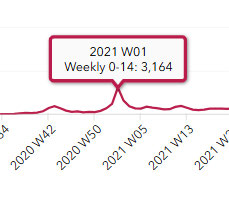
Source: hpsc.ie32
Reopening Schools Once and For All
After how poorly the initial reopening of schools went in Autumn 2020, the Government tasked an Expert Group to work on “The Role of Ventilation in Reducing Transmission of COVID-19”33 and to provide supplemental information to reduce airborne transmission in schools.34
The purpose of this Expert Group was to provide scientific advice on the role of ventilation and other control measures in mitigating against the risk of long-range (airborne) transmission of SARS-CoV-2. The Group had a wide range of multi-disciplinary expertise in indoor air quality and related areas including aerosol science, architecture, engineering, regulation, occupational hygiene, exposure science, virology, microbiology and public health medicine.
The expert guidance emphasised that “ventilation should be delivered as part of a layered strategy of protective measures to control the spread of the virus that causes COVID-19. These protective measures include physical distancing and the wearing of well-fitting, multi-layer face-coverings. Along with these preventative actions, ventilation further reduces the risk of COVID-19 transmission in schools.”
The entire document is worth reading but we wish to highlight what had been emphasised by the Expert Group as published in March 2021:
“There are some additional points worth emphasizing:
- Maximise ventilation to ensure that the occupants in a space achieve as much access to outdoor air as possible.
- Maximise both natural and mechanical ventilation in break rooms and canteens which are areas of particular concern, due to risks of close contacts, face to face contact and removal of masks for eating and drinking.
- Ensure optimised ventilation in corridors, staircases, toilets, changing rooms and other enclosed spaces, particularly where there are low ceilings.
- Activities that may generate high levels of respiratory aerosols (shouting, singing, playing wind instruments or physical exercise) are likely to pose the greatest risk and should only be performed in well-ventilated large halls or outdoors.
- Consider moving activities to larger, well-ventilated indoor areas or outdoors if the weather permits.
- In places which rely on natural ventilation, emphasize the importance of cross ventilation and diagonal air-flow through rooms for maximising ventilation rates.
- External weather conditions (wind speed and direction, temperature) can significantly affect natural ventilation. It is important to remember that a room which is well ventilated on one day may be substantially different the next.
- Mechanical ventilation systems should be checked to ensure that they are working as designed and set to operate on 100% fresh air.
- Ensure the ventilation strategies do not compromise fire safety. Fire doors should not be held open unless fitted with automatic-closing devices.
- Take particular precautions in enclosed spaces that may have higher risks of inadequate ventilation, such as temporary structures and converted buildings that may have been built for another use.
Monitoring Ventilation
- Measurements of carbon dioxide (CO2) levels in indoor air are an effective method foridentifying inadequate ventilation in multi-occupant spaces. Only CO2 monitors based on non-dispersive infrared (NDIR) technology should be used. The manufacturer’s guidelines should be followed during use.
- Consider using a portable carbon dioxide (CO2) monitor to identify areas of the school with inadequate ventilation. Measurements taken over several days can provide useful information on the impact of occupancy, occupant activity and outdoor weather conditions on ventilation efficiency. This information can be used to inform strategies for improving ventilation.
- In classrooms, CO2 monitors can provide visual or audible alerts (such as “traffic-light” warnings) to teachers and pupils to indicate elevated concentrations of CO2 and inadequate ventilation. The measurements can inform ways to optimise ventilation using the guidance provided in Practical Steps for the Deployment of Good Ventilation Practices in Schools, Department of Education.
Additional Measures to reduce transmission risk in poorly ventilated spaces
- In areas with poor ventilation or where CO2 monitoring has shown ventilation is likely to be inadequate for the number of occupants, structural intervention and measures to increase natural ventilation should be completed.
Where such structural interventions or measures are not possible in the short term, consider using standalone high efficiency particulate air (HEPA) filter devices to further reduce airborne virus in poorly ventilated spaces. These devices do not require specialist installation and are a cost-effective short term mitigation measure, but in the longer run, permanent improvements to ventilation should be made. HEPA-filter devices should be correctly sized to the room, and consideration should be given to two or more smaller units placed around the room, rather than one large unit.
Where possible select units with low noise levels and ensure they are positioned according to manufacturer’s instructions, and are not a hazard to students. - Ensure exhaust fans in toilets are operating at full capacity while the school is occupied. Consider installing exhaust fans in toilets that may have inadequate ventilation.
- Flush toilet with lid down to reduce aerosolization and risk of fecal-oral transmission.
- Ensure that good ventilation is implemented along with other precautions (face coverings, physical distancing) while travelling to and from school in vehicles.
Future Proofing
Most of the information and advice contained in this document is aimed at supporting short-term mitigations. Where schools have identified specific areas with inadequate ventilation, they should utilise the holiday periods to implement permanent structural improvements to address ventilation needs. Good indoor air quality has other measurable benefits, including improved performance of children in classrooms, reduced disease spread, and a reduction in other harmful pollutants. Longer term structural improvements may be needed to ensure that schools achieve a balance between energy efficiency, occupant comfort and ventilation for public health.
It is recommended that strategies to deliver these longer term measures are progressed and reflected in the relevant technical guidance, in line with ongoing and emerging research.”35
By mid- March 2021, all schools had reopened once again. Accounts from members of CAAI who worked in schools at the time or had children in schools at the time found that the expert guidance was not being followed in many schools. Gradually Minister for Education Norma Foley eroded the messaging within the Expert Guidance with her own interpretation, suggesting windows need not be open throughout the day in response to complaints of cold.36 HEPA filters were not deployed uniformly across all classrooms and CO2 monitors were not available to every classroom.37
Impact of Covid-19 on Children in School
By the 5th April 2021, according to minutes and agendas from meetings of the NPHET: COVID-19, there had been 33,655 cases of Covid-19 in the 0-18 year old population since March 2020, representing 2.9% of the 0-18 population. Since week 6, 2021, 164 outbreaks had been reported associated with schools and childcare facilities.38
Despite assurances from the HSE and Government officials that children aren’t likely to get infected with Covid-19 and that “schools are safe”, Infectious Disease Notifications Data for Covid-19 in 2022 tell a different story.39
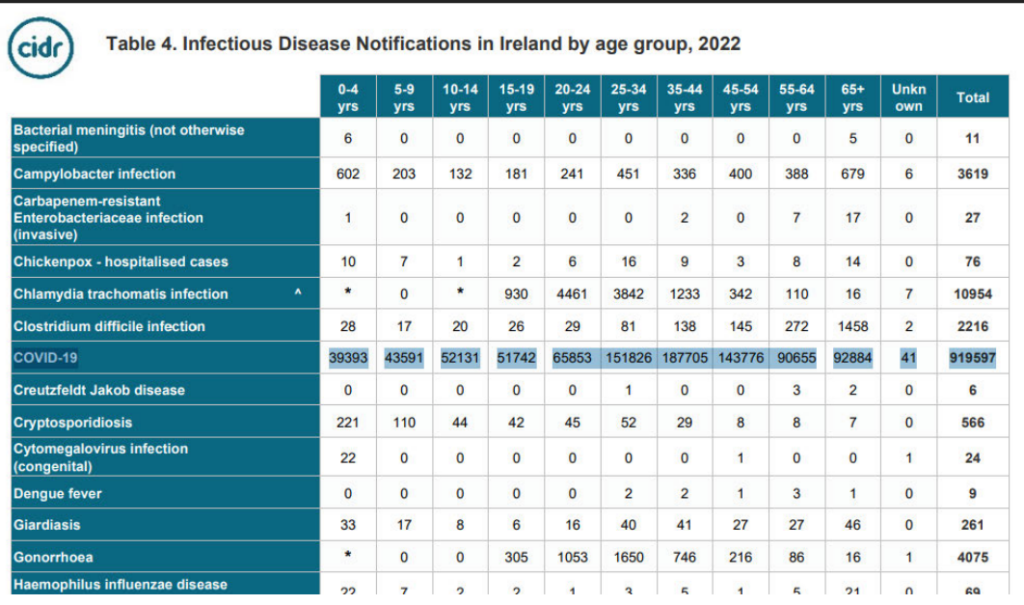
186,857 confirmed Covid-19 infections in children and young people between 0 and 19 were documented in 2022.
Conclusion
In the early days of the pandemic, SARS-CoV-2 was considered to be of lower risk to children without clear scientific evidence to back this claim. The precautionary principle should have applied in face of uncertainty regarding long term sequelae. As a result, schools reopened and classroom environments gradually returned to “pre-pandemic normalcy”, i.e. there has been less emphasis on classroom ventilation and use of CO2 monitors to assess ventilation, or use of HEPA filters in classrooms to filter airborne pathogens. In addition, Covid vaccines are not easily available to the majority of children—children between 6 months and 12 yrs of age can only access vaccines through public health nurse appointments and are not routine vaccines.
Extensive scientific research now shows that children are in fact vulnerable to SARS-CoV-2 infections, with effects lasting beyond the acute phase of infection. A recent Centre for Disease Control and Prevention study suggests that school-aged children in the US diagnosed as having Long COVID are at 2.5 times the risk of related chronic absenteeism compared with those without the condition. The study, published in Emerging Infectious Diseases, also found double the prevalence of memory impairment, problems concentrating, and learning difficulties in this group. The researchers used data from the 2022 and 2023 US National Health Interview Surveys to evaluate functional limitations and illness-related chronic absenteeism in a nationally representative sample of 11,057 children aged 5 to 17 years comparing those who had Long Covid with those who hadn’t.40
There is also a chronic absenteeism crisis in Irish schools as the number of children missing 20+ days/year has more than doubled since the onset of the COVID pandemic, affecting 1 in 5 students.41 While there is no reliable data on Long COVID rates amongst children in Ireland,42 the pattern of school absenteeism due to illness is also being observed here.
In 2023-24, there were 94,501 students who lost 20-plus days at primary level, representing 22.1% of the student population. The percentage of students absent for 20 days or more at primary level is 8.41 points above the long run average (2003-2023) of 13.64%.
At post-primary level, 67,612 students lost 20 or more days, representing 21.2% of the student population.
At post-primary level, the percentage of students absent for 20-days or more is 4.48 points above the long run average of 16.7%. Both figures remain well above the pre-pandemic averages of 11.43% and 16.19% for primary and post-primary respectively.43
In 2023–24, the category of illness accounted for the highest number of absences in primary schools for the third consecutive year, representing 39.9% of days lost. In post-primary schools, “unexplained” absences accounted for the largest share of absences at 52.7%, also for the third consecutive year.44
We know now that many pathogens are spread via aerosols, and that some of the post-viral sequelae of SARS-CoV-2 infections in children include cardiovascular disease,45 immune dysregulation, anxiety, memory and mental health issues.46 Such a drastic increase in school absence rates amongst school children in Ireland underscores the urgency of implementing comprehensive IAQ measures to prevent further damage being caused to children from airborne pathogens like SARS-CoV-2.
We submit that continuous livestreamed Indoor Air Quality (IAQ) Monitoring and HEPA filters should be required by regulation and distributed throughout all classrooms. This is in line with the early recommendations made by the Expert Group on Ventilation.47 Continuous IAQ monitoring would enable students, staff and parents to view the air quality of a classroom and to allow for steps to be taken to improve the air quality in the indoor environment. Whether that be opening windows, installing extra HEPA filters, or identifying a point source for poor air quality.
We propose that to be better prepared for new pandemics, greater efforts should be made now to destigmatise and depoliticise the use of respirators. There was an opportunity at the beginning of the pandemic to upgrade ventilation and improve indoor air quality during the lockdown and holiday periods over the past 6 years. There is still work to be done on upgrading ventilation systems across public buildings, particularly schools to avoid lengthy lockdowns the next time a pandemic arrives on our shores.
Clean Air Advocacy Ireland would welcome the opportunity to discuss this submission further.
Sinéad O’Brien
Clean Air Advocacy Ireland Drumsheel Upper
Cong, Co. Mayo
Phone:
Website: www.cleanairadvocacyireland.org
Footnotes
1 https://www.who.int/europe/news/item/12-06-2023-with-the-international-public-health-emergency-ending–who-europe-launches-its-transition-plan-for-covid-19
2 https://www.rte.ie/news/election-2020/results/#/national
3 EU Member States, including Ireland, adopted a negotiating mandate for the future relationship at a meeting of the General Affairs Council on 25 February 2020, authorising the Commission’s UK Task Force (UKTF) led by EU Chief Negotiator Michel Barnier, to begin negotiations.
Negotiations on the future relationship between the EU and the UK began on 5 March and an agreement in principle was reached on 24 December 2020. This agreement came into effect on 1 January 2021.
4 https://www.theguardian.com/politics/2020/jan/11/northern-ireland-assembly-reopens-three-years-after-collapse
5 https://www.theguardian.com/world/2020/feb/06/whistleblower-chinese-doctor-dies-from-coronavirus
6 https://www.irishmirror.ie/news/irish-news/st-patricks-day-cancelled-coronavirus-21703175 And https://www.rte.ie/news/politics/2020/0303/1119999-st-patricks-day-politics/
7 https://www.irishtimes.com/life-and-style/health-family/cheltenham-2020-face-masks-were-as-rare-as-a-100-1-winner-1.4495053
8 https://www.irishtimes.com/news/ireland/irish-news/coronavirus-full-list-of-events-cancelled-in-ireland-1.4197421
9 https://www.oireachtas.ie/en/debates/debate/dail/2001-03-02/3/
10 Julien Guillaumond, Vanessa Boullet. ‘Covid-19 and the Irish Border. A Preliminary Analysis of Cross Border Cooperation Considering Health and Work Issues.’ Revue française de civilisation britannique, 2023, La pandémie de Covid-19 au Royaume-Uni, XXVIII (2), ff10.4000/rfcb.11048ff. ffhal-04482793f . Available at: https://hal.science/hal-04482793/document
11 https://www.irishexaminer.com/news/arid-40068155.html#:~:text=Taking%20a%20zero%2DCovid%20approach%20is%20%22not%20credible%22%20as,Mr%20Martin%20told%20the%20D%C3%A1il.
12 https://www.theguardian.com/world/2020/mar/13/herd-immunity-will-the-uks-coronavirus-strategy-work
13 A 2025 inquiry into the UK’s handling of the pandemic found that a one-week delay in implementing the first lockdown in March 2020 resulted in roughly 23,000 more deaths in England’s first wave than if it had been introduced earlier. https://www.bbc.com/news/articles/c8030xvvlv0o
14 https://www.rte.ie/news/coronavirus/2020/0328/1127002-coronavirus-2km-limit/
15 Particularly as examples of cyclists going for long cycles were being penalised for breaching their 5km limit. https://www.irishmirror.ie/news/irish-news/gardai-list-unreasonable-excuses-5km-23324079
16 Morawska et. al., ‘Airborne transmission of SARS-CoV-2: The world should face the reality’, Environment International Volume 139, June (2020), 105730, Available at: https://www.sciencedirect.com/science/article/pii/S016041202031254X See also: ‘The 60-Year-Old Scientific Screwup That Helped Covid Kill,’ Available at: https://www.wired.com/story/the-teeny-tiny-scientific-screwup-that-helped-covid-kill/
17 Wang CC, Prather KA, Sznitman J, Jimenez JL, Lakdawala SS, Tufekci Z, Marr LC., ‘Airborne transmission of respiratory viruses.’ Science (2021);373(6558): eabd9149. doi: 10.1126/science.abd9149. PMID: 34446582; PMCID: PMC8721651. Available at: https://pmc.ncbi.nlm.nih.gov/articles/PMC8721651/#:~:text=Virus%2Dladen%20aerosols%20(%3C100, both%20short%20and%20long%20ranges.
18 https://hselibrary.ie/wp-content/uploads/2021/01/Evidence-Summary-COVID-19-Long-COVID.pdf
19 Ibid.
20 John P.A. Ioannidis, Thomas A. Collins, Eran Bendavid, Jeroen Baas, ‘Massive covidization and subsequent decovidization of the scientific literature involved 2 million authors,’ Journal of Clinical Epidemiology, Volume 180, 2025, 111705, ISSN 0895-4356 (https://www.sciencedirect.com/science/article/pii/S0895435625000381) And most recently in ‘Identifying subtypes of Long COVID: a systematic review’, Wang, Bingyi et al. eClinicalMedicine, Volume 91, 103705 Available at:
21 For Secondary and Primary schools respectively.
22 Interim HSE advice in relation to return to school and the ‘extremely medically vulnerable’. Update date: 01/09/2020 Available at: %E2%80%98extremely-medically-vulnerable%E2%80%99.pdf
23 Just one example from Deputy Marc MacSharry, “While schools are safe, it should be recognised that staff with underlying conditions and those who care for elderly or vulnerable relatives at home have legitimate concerns about Covid-19.” https://www.oireachtas.ie/en/debates/debate/dail/2021-01-14/6/#:~:text=While%20schools%20are%20safe%2C%20it,have%20legitimate%20concerns%20about% 20Covid%2D19.
24 https://respiratoryvirus.hpsc.ie/pages/covid-19
25 https://www.gov.ie/en/department-of-the-taoiseach/publications/briefing-on-the-governments-response-to-covid-19-friday-18-december-2020/
26 https://assets.gov.ie/static/documents/roadmap-for-the-full-return-to-school.pdf
27 Interim HSE advice in relation to return to school and the ‘extremely medically vulnerable’. Update date: 01/09/2020 Available at: %E2%80%98extremely-medically-vulnerable%E2%80%99.pdf
28 https://assets.gov.ie/static/documents/agenda-2ai-covid-19-in-children-and-data-on-schools-and-childcare-facilities-2021_hpsc.pdf
29 https://www.gov.ie/en/department-of-the-taoiseach/press-releases/ireland-placed-on-level-5-of-the-plan-for-living-with-covid-19/
30 https://www.gov.ie/en/department-of-the-taoiseach/speeches/address-by-the-taoiseach-miche%C3%A1l-martin-td-on-ireland-placed-on-level-3-of-the-plan-for-living-with-covid-19-with-special-measures-for-a-safe-christmas/
31 Chief Medical Officer Tony Holohan announced that more cases had been confirmed in one month than throughout 2020 with over 1,000 deaths and more than 100,000 cases confirmed in January 2021.
Available at: https://www.gov.ie/en/department-of-health/press-releases/statement-from-the-national-public-health-emergency-team-saturday-30-january/
32 https://respiratoryvirus.hpsc.ie/pages/covid-19
33 https://www.gov.ie/en/department-of-health/publications/expert-group-on-the-role-of-ventilation-in-reducing-transmission-of-covid-19/#reports
34 https://assets.gov.ie/static/documents/ventilation-and-related-measures-to-reduce-airborne-transmission-of-covid-19-in-school.pdf
35 Ibid
36 https://www.breakingnews.ie/ireland/education-minister-suggests-opening-windows-at-lower-level-if-classrooms-are-cold-1239506.html
37 Ibid.
38 https://assets.gov.ie/static/documents/agenda-2ai-covid-19-in-children-and-data-on-schools-and-childcare-facilities-2021_hpsc.pdf
39 https://www.hpsc.ie/notifiablediseases/annualidstatistics/Annual_ID_Summary_Report_for_HPSC_Web
40 Ford ND, Simeone RM, Pratt C, et al. Functional Limitations and Illness-Related Absenteeism among School-Aged Children with and without Long COVID, United States, 2022–2023. Emerging Infectious Diseases. 2025;31(14):11-19. doi:10.3201/eid3114.251035. Available at: https://wwwnc.cdc.gov/eid/article/31/14/25-1035 article#;
41 Moya et al. ‘School-level patterns of non-attendance, 2022/23 and 2023/24’, ESRI, (January 2026). Available at: https://www.esri.ie/publications/school-level-patterns-of-non-attendance-2022-23-and-2023-24
42 The FADA study carried out by the HSE found that 16% of adults reported Long COVID symptoms post infection, but children were unfortunately excluded from this study.
43 TUSLA Education Support Service, ‘School Attendance Data Primary and Post-Primary Schools And Student Absence Reports Primary and Post-Primary Schools 2023-2024’ (February 2025), Available at: https://www.tusla.ie/uploads/content/Analysis of School Attendance Data 2023-24.pdf
44 IBID
45 Zhang, B., Thacker, D., Zhou, T. et al. ‘Cardiovascular post-acute sequelae of SARS-CoV-2 in children and adolescents: cohort study using electronic health records.’ Nat Commun 16, 3445 (2025). https://doi.org/10.1038/s41467-025-56284-0 Available at: https://www.nature.com/articles/s41467-025-56284-0
46 Boyarchuk O, Volianska L. ‘Autoimmunity and long COVID in children.’ Reumatologia (2023); 61(6):492- 501. doi: 10.5114/reum/176464. Epub 2024 Jan 18. PMID: 38322108; PMCID: PMC10839920. Available at: https://pmc.ncbi.nlm.nih.gov/articles/PMC10839920/ Ortega-Martin E, Richards-Belle A, Newlands F, Shafran R, Stephenson T, Rojas N, et al. ‘Children and young people with persistent post-COVID-19 condition over 24 months: a mixed-methods study.’ BMJ Paediatrics Open. 2025;9:e003634. https://doi.org/10.1136/bmjpo-2025-003634 Available at: https://bmjpaedsopen.bmj.com/content/9/1/e003634
47 https://assets.gov.ie/static/documents/ventilation-and-related-measures-to-reduce-airborne-transmission-of-covid-19-in-school.pdf