CORAL Study Research Group, RCSI
Submission to independent COVID-19 Evaluation
Introduction
The children born in Ireland during the first wave of the pandemic (March-May 2020) experienced their early life development in the context of unprecedented public-health restrictions(1). They lived with level 5 lockdown restrictions for 87% of their first year of life(2).
In June 2020, RCSI established a prospective, longitudinal, observational study –“CORAL: Impact of CORona Virus Pandemic on ALlergic and Autoimmune Dysregulation in Infants Born During Lockdown” involving children born in two Dublin maternity hospitals between March and May 2020 and studied them until they reached two years of age in 2022. They were SARS-CoV-2 antibody tested at 6-months and 1 year, had stool samples and biophysical evaluations at 6 months, 12 months and 2 years. This is the only such group of “born in lockdown” children established anywhere in the world. The study to date has yielded unique insights into childhood firstly under extreme social isolation and then during the societal recovery from those social restrictions.
In 2025, with funding from Research Ireland, RCSI recruited another cohort of babies in the identical months, March-May, to examine how children are being parented and responding to life in their early months without lockdown restrictions. This study is called “FLORAL: FoLow on from CORAL” andrecruited from all three maternity hospitals in Dublin. One work package in FLORAL is a follow up of the original CORAL babies, who turned 5 years of age in 2025. They underwent repeat biophysical and neurodevelopmental tests.
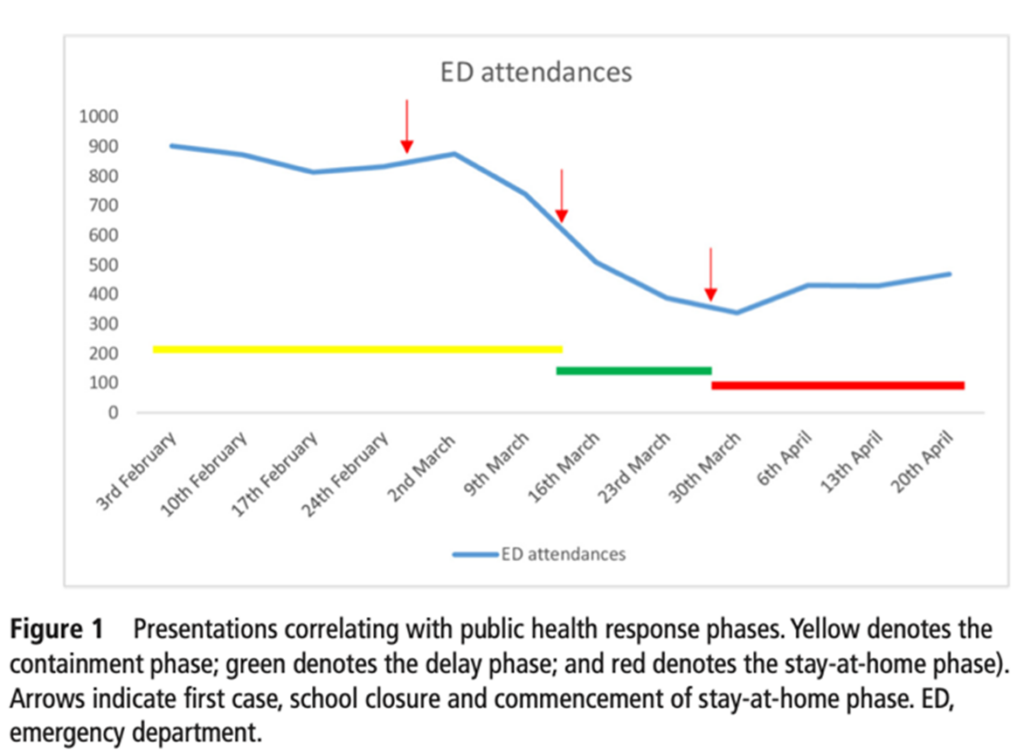
Early in the lockdown during 2020, RCSI and partners at CHI Temple St published data to show dramatic differences in emergency department (ED) attendance as children had to stay home and were not experiencing the normal rates of viral infections that often lead to ED reviews as shown in Figure 1(3).
CORAL Study Findings
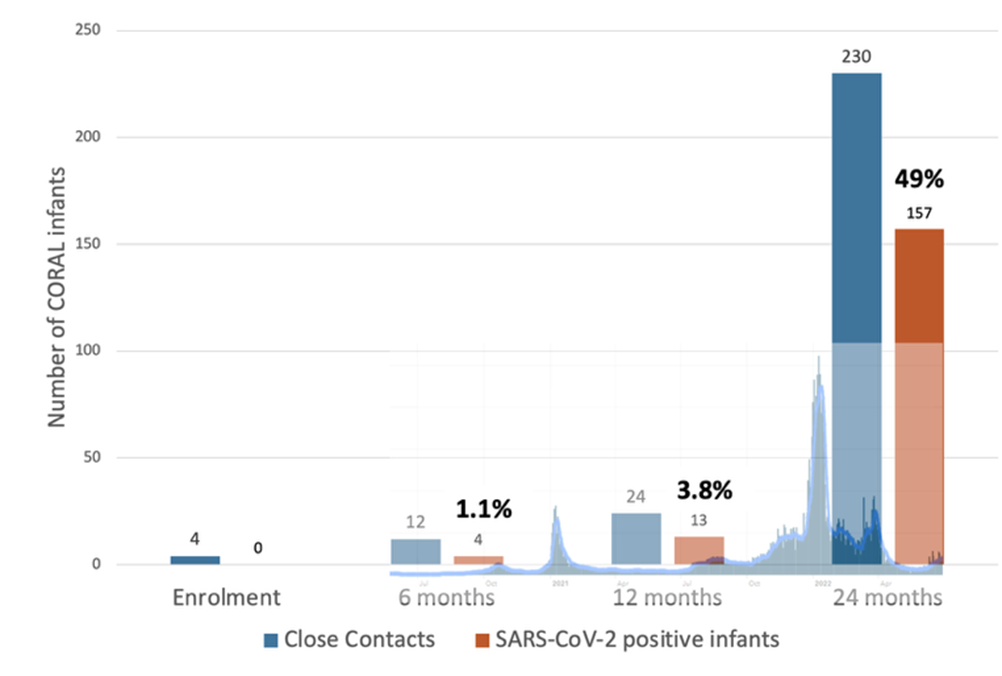
The first finding of significance from CORAL in 2020 showed that lockdown was extremely successful in protecting young infants from COVID-19 infection. At 6 months only 4/360 (1%) of children showed SARS-CoV-2 antibodies, indicating exposure. At 12 months, after the second and third waves of community spread, parental reports of positive PCR tests and repeat antibody testing showed only 16/344 (4.7%) of infants had been infected with SARS CoV-2 infection by their first birthday. Notably 5 of these 16 children had already become antibody negative by 12 months(4).
By 2 years, 47% of children had been infected with SARS-CoV-2 (Figure 2). The Omicron surge had happened when the children were about 20 months old and social restrictions had been eased.
Overall these data show that without lockdown many babies would have been exposed and infected with SARS-CoV-2, with the attending health consequences.
Figure 2.
Secondly, routine healthcare access for immunisation was reassuringly very high, actually exceeding normal rates for 2-, 4- and 6-month vaccinations. It was inferred that parental motivation to complete vaccination remained high and, anecdotally, families reported to the study that medical appointments were positively anticipated permitted excursions from home. This also applied to the CORAL in-person study visits at 6- and 12-months.
Thirdly, 38% of infants were exclusively breastfed at 6 months and a further 15% were still being breastfed, but not exclusively. These are much higher rates compared to previous rates in Ireland before the pandemic(5). Breastfeeding at 12 months was also much higher (35%) than Irish norms, suggesting working from home after maternity leave facilitated mothers continuing to breastfeed, which they often say they cannot manage when they have to return to work after their statutory maternity leave of 6-months. 7.5% of babies had been admitted to hospital in the first 6-monthsand and antibiotics had been prescribed for only 25 infants (7%). These are both much lower rates than seen in other European countries before the pandemic(2, 6).
Fourthly, Food allergy and eczema are the most common allergic conditions in infants, and the CORAL study was based on the conjecture/proposition that decreased community exposure to viral infections might increase the rates of these allergic conditions. In fact, CORAL did not show increases in these conditions. This was hypothesised to be due to the extended exclusive breastfeeding and by extended exposure to siblings, both being factors that increased the more favourable intestinal bacterial milieu called the microbiome, with higher rates of “favourable” lactobacilli and lower rates of “adverse” clostridial species. Of the 354 babies recruited to the CORAL study, by 6-months of age, only 3 people had kissed the baby including their parents and by 12-months a quarter of the children in the study had never met another child of the same age(4). Infants with no siblings and few social contacts had less favourable gut microbiome profiles(7).
The regular contact with the allergy-aware CORAL study team was felt to be the reason for the improved rates of introduction of allergenic foods, which was existing HSE/national advice, but it had very low uptake previously. Lower rates of food allergy and eczema signals were seen in children who had vegetable and nuts/seeds/pulses included early in their weaning diet, with diverse diets being favourable and less diverse diets being “adverse”. This has implications for all babies in the future and the provision of fresh, diverse foods to isolated and disadvantaged families could be a target of pandemic planning.
The FLORAL study is ongoing with the 6-month visits completed and 12-months visits finishing in May 2025. Hospitalisations (13%), infections (33%) and antibiotic prescriptions (13%) by 6-months have all increased in babies born in 2025 compared to those born in 2020 lockdown, but exclusive breastfeeding has remained high at 38% at 6-months (September- November 2025, Sokay et al, submitted, paper 1).
The CORAL subjects turned 5 years old in 2025 and continue to show low rates of food allergy but are acquiring the typical allergies of mid childhood, such as asthma, allergic rhinitis and hay fever at the expected rate, not slower or faster. Therefore, it is evident that early life isolation has not affected longer term allergic presentations (Sokay et al, submitted paper 2).
Finally, there is a complex relationship between pandemic exposure and early life neurodevelopment, with the most consistent finding between studies showing an association with speech delay(8). We know from the literature on human and animal studies that social isolation and early life adversity is associated with differential gene expression which can alter neurodevelopmental trajectories(9-12). Previously published work from the CORAL study group demonstrated reduced social communication skills at 12-months, still evident at 24-months(13, 14), as well as pandemic-born infants showing less interest in masked than unmasked faces(15), which was hypothesised to have an effect on language attainment.
Through follow-up of the CORAL cohort at 12 months, 2 years and 5 years, the FLORAL study has been able to compare their Ages and Stages Questionnaire-3 results (ASQ) at each of the three timepoints. The ASQ is a widely used developmental screening tool designed to identify children at risk of developmental delay across 5 subdomains: Communication, Gross Motor, Fine Motor, Problem-Solving and Personal – Social(16). Primary mixed effects analyses on complete ASQ data (n=185) showed a reassuring improvement overall in total Communication scores as well as reduced odds by 60-months of scoring below a cut-off from clinical concern in the Communication subdomain. Early developmental vulnerabilities in Communication and in the Problem-Solving domain were largely improved by 60-months. In fact, there were improvements seen in the total scores between 24- and 60-months in all domains, apart from Fine Motor. This may be evidence of developmental resilience, where improvements are appreciated once the typical environments for social interaction are introduced.
It was noted that fine motor scores deteriorated consistently across time. It is difficult to firmly conclude if that finding is pandemic specific, but other studies have also found reduced fine motor skills in pandemic born children compared to a pre-pandemic cohort(17). Reduced fine motor skills may be a result of reduced access to the structured traditional creative play with peers in the pandemic, or a more general societal increase in children’s screentime, where children are spending more time with digital devices and less time hands-on interacting with three-dimensional experiences for building and traditional play.
When the lock-down measures were eased from May 2021, the children of the CORAL cohort were aged between 12-14 months, a relatively early developmental age. There is evidence in the published literature from the Bucharest Early Intervention Project and the English & Romanian Adoptees Study for developmental plasticity despite early life social isolation when taken out of those environments at an early developmental stage(18, 19).
There is room for optimism regarding the medium term developmental outcomes of pandemic born infants in Ireland and the neurodevelopmental resilience of children generally. It is important that there is continued developmental surveillance and access to early intervention, this may help to mitigate or reduce early developmental disruptions in the case of any future public health crises.
Summary
Social lockdown protected newborn infants from SARS-CoV-2 infection in 2020-2021 and led to more favourable gut health in infancy, mediated by the opportunity for mothers in Ireland to breastfeed exclusively for longer than the norm in Ireland and, with blended “in office” and “from home” working patterns, to continue mixed breast and formula feeding to 12 months and later. This pattern may need to be promoted or accommodated more as it has positive consequences for infant nutrition and health outcomes.
However social isolation, especially for first born children, without siblings, had some adverse immunological and neurodevelopmental consequences. Lower communication skills and language scores were seen at 12 months and 2 years but they had largely improved by 5 years of age. Externalising behavioural problems such as attention/hyperactivity problems and oppositional defiant problems are higher at 5 years in the CORAL babies born in lockdown compared to a pre-pandemic Irish birth cohort. This research finding supports anecdotal parental and teacher reports in the media about how the 2020 babies have coped in their first year in primary school 2025-2026(20).
Ireland has the only research group with this exclusive cohort of children born during the pandemic, enabling the unique longitudinal study of this population.
References:
1. ÓhAiseadha C, Quinn GA, Connolly R, Wilson A, Connolly M, Soon W, et al. Unintended Consequences of COVID-19 Non-Pharmaceutical Interventions (NPIs) for Population Health and Health Inequalities. International Journal of Environmental Research and Public Health. 2023;20(7):5223.
2. Lawler M, Franklin R, McCallion N, Byrne AM, Fitzsimons J, Kinoshita M, et al. The impact of COVID-19 lockdown on infants’ coronavirus exposure and routine healthcare access in Ireland: The CORAL birth cohort study at 6 months. Pediatr Allergy Immunol. 2021;32(8):1876-9.
3. Dann L, Fitzsimons J, Gorman KM, Hourihane J, Okafor I. Disappearing act: COVID-19 and paediatric emergency department attendances. Arch Dis Child. 2020;105(8):810-1.
4. Sledge H, Lawler M, Hourihane J, Franklin R, Boland F, Dunne S, et al. Parenting a newborn baby during the COVID-19 pandemic: a qualitative survey. BMJ Paediatr Open. 2022;6(1).
5. Gallagher L, Begley C, Clarke M. Determinants of breastfeeding initiation in Ireland. Ir J Med Sci. 2016;185(3):663-8.
6. Hurley S, Franklin R, McCallion N, Byrne AM, Fitzsimons J, Byrne S, et al. Allergy-related outcomes at 12 months in the CORAL birth cohort of Irish children born during the first COVID 19 lockdown. Pediatr Allergy Immunol. 2022;33(3):e13766.
7. Korpela K, Hurley S, Ford SA, Franklin R, Byrne S, Lunjani N, et al. Association between gut microbiota development and allergy in infants born during pandemic-related social distancing restrictions. Allergy. 2024;79(7):1938-51.
8. Hurley T, Hourihane J, Byrne S. Understanding the Complex Effects of the COVID-19 Pandemic on Infant Development. JAMA Netw Open. 2025;8(9):e2530354.
9. Tebbenkamp AT, Willsey AJ, State MW, Sestan N. The developmental transcriptome of the human brain: implications for neurodevelopmental disorders. Curr Opin Neurol. 2014;27(2):149-56.
10. Dunn EC, Soare TW, Zhu Y, Simpkin AJ, Suderman MJ, Klengel T, et al. Sensitive Periods for the Effect of Childhood Adversity on DNA Methylation: Results From a Prospective, Longitudinal Study. Biol Psychiatry. 2019;85(10):838-49.
11. Peña CJ, Smith M, Ramakrishnan A, Cates HM, Bagot RC, Kronman HG, et al. Early life stress alters transcriptomic patterning across reward circuitry in male and female mice. Nat Commun. 2019;10(1):5098.
12. Gunnar MR, Bowen M. What was learned from studying the effects of early institutional deprivation. Pharmacol Biochem Behav. 2021;210:173272.
13. Byrne S, Sledge H, Franklin R, Boland F, Murray DM, Hourihane J. Social communication skill attainment in babies born during the COVID-19 pandemic: a birth cohort study. Arch Dis Child. 2023;108(1):20-4.
14. Byrne S, Sledge H, Hurley S, Hoolahan S, Franklin R, Jordan N, et al. Developmental and behavioural outcomes at 2 years in babies born during the COVID-19 pandemic: communication concerns in a pandemic birth cohort. Archives of Disease in Childhood. 2023;108(10):846-51.
15. Byrne S, Flaherty E, Sledge H, Lenehan S, Jordan N, Boland F, et al. Infants born during the COVID-19 pandemic have less interest in masked faces than unmasked faces. Archives of Disease in Childhood. 2023;108(10):i.
16. Muthusamy S, Wagh D, Tan J, Bulsara M, Rao S. Utility of the Ages and Stages Questionnaire to Identify Developmental Delay in Children Aged 12 to 60 Months: A Systematic Review and Meta-analysis. JAMA Pediatr. 2022;176(10):980-9.
17. Kotzsch A, Papke A, Heine A. The Impact of the COVID-19 Pandemic on the Development of Motor Skills of German 5- to 6-Year-Old Children. Behav Sci (Basel). 2025;15(3).
18. Windsor J, Benigno JP, Wing CA, Carroll PJ, Koga SF, Nelson III CA, et al. Effect of Foster Care on Young Children’s Language Learning. Child Development. 2011;82(4):1040-6.
19. Nelson CA, Fox NA, Zeanah CH. Romania’s Abandoned Children: The Effects of Early Profound Psychosocial Deprivation on the Course of Human Development. Curr Dir Psychol Sci. 2023;32(6):515-21.
20. Egan S, Pope J. Infants of the Pandemic: Teacher Perspectives on the Early Development and School Readiness of Children Starting School in September 2024 2025.