Jigsaw
Introduction
Firstly, thank you for the invitation to contribute to your important work. We appreciate this opportunity
and hope to add value to your deliberations in this important area.
As an organisation at the forefront of understanding the mental health needs and experiences of young
people, we, at Jigsaw, have been supporting the mental health needs of Ireland’s youth since 2006 and
believe our ever-evolving and holistic models of service and support provision have, and will continue to,
add value to many across Ireland.
As you are well aware, on March 12th, 2020 Ireland entered uncharted territory. In the face of the global
Covid-19 pandemic, public health advice forced many to rethink how we live our lives and for Jigsaw, it
forced us to rethink how we continue to be there for young people and those around them.
From early on, we were acutely aware that Covid-19, and the measures taken to contain it, had the
potential to negatively impact our young people’s mental health. The restrictions (though necessary),
along with a looming global threat, took aim to our collective need for closeness in personal relationships
with family and friends; for autonomy and control; for direction and more – all key components of positive
mental health.
This unprecedented, prolonged, and unpredictable crisis clearly posed many increased risks to the mental
health of children and young adults.
Just as the Covid-19 situation evolved and changed, so too has our response here in Jigsaw. As recognised
through an European Citizens Prize in 2022, a huge collective effort saw our teams across the country work
tirelessly to re-orientate our organisation, to rethink how we operate and to develop a full range of
information, supports, advice and services for young people, their parents and educators.
For Jigsaw, Covid19 was the catalyst for fresh thinking – it has demonstrated to us, as an organisation, that
new ways working are feasible and that digital interventions must be central to all future thinking. But
most importantly, it demonstrated the true value in our approach at primary care level – in session rooms,
in classrooms, in lecture halls, on sports grounds, workplaces, homes and more – these settings, both
physical and digital, must be the new and fertile ground for improved mental health.
The impact of Covid 19 on young people’s mental health
The impact of the pandemic, and the measures taken to contain it, may well have long a lasting impact on
the collective mental health and well-being of our young people.
National and international research point to a potential wave of mental-health problems fast approaching
as we collectively adapt to our new and unsettling reality.
Mental health professionals and researchers have expressed concerns that exposure to the COVID‐19
pandemic during a vulnerable developmental stage places young people at greater risk of the negative
psychological impacts of such an event (Holmes et al., 2020).
Additionally, a number of reviews have indicated the pandemic has adversely impacted the mental health
of young people, particularly those living with pre‐existing psychological and contextual vulnerabilities,
although the quality of this evidence is mixed and typically generated from cross‐sectional studies (de
Miranda et al., 2020; Jeffery et al., 2021; Nearchou et al., 2020).
At the same time, longitudinal studies monitoring mental health across the pandemic point to a reduction
in the number of young people reporting difficulties since the initial lockdown period in Europe, and have
detected improved wellbeing for some young people (Fancourt et al., 2021; Raw et al., 2020; Shanahan et
al., 2020). This demonstrates a more nuanced picture of the psychological impacts of the pandemic, with
the true impact of COVID‐19 not yet fully understood.
By comparison, there has been less focus on the potential impact of the COVID‐19 pandemic on
engagement with youth mental health services, which have historically been under resourced, not
developmentally sensitive or youth‐oriented, inaccessible and siloed (Hetrick et al., 2017; O’Reilly et
al., 2015).
Further, hard indicators of mental health service use such as referrals to services, hospital admissions,
emergency department (ED) presentations and appointments booked/attended may be useful in
estimating the psychosocial effect of the pandemic (Clerici et al., 2020).
While not specific to youth mental health services, a handful of studies have shown reduced rates of
presentations to EDs and psychiatric admission rates during the initial period of COVID‐19 restrictions, and
a further study reported reduced service use at four headspace youth mental health services during the
same period (Clerici et al., 2020; McAndrew et al., 2020; McIntyre et al., 2020; Nicholas et al., 2021;
Steward et al., 2020; Szmulewicz et al., 2021). Conversely, one study reported a small increase in
children/adolescents presenting to an Irish ED for mental health reasons between March and May 2020,
whilst a report on engagement with an Australian digital mental health service found an increase in
telephone and website contacts, particularly from females, in the early COVID‐19 period (McAndrew et
al., 2020; Titov et al., 2020). Several contributors have cautioned that observed decreases may represent
an unmet need among the population, and have suggested further research is needed to determine how
mental health service use varies across the pandemic.
Managing any increase in demand for mental health services is particularly challenging in the context of
service disruptions. Mental health services in most countries have had to temporarily close and/or radically
reconfigure their services to accommodate public health measures associated with the COVID‐19
pandemic, such as physical distancing and minimizing in‐person contact, whilst also dealing with
suspected/confirmed cases of COVID‐19, staff illness and redeployment (Fegert & Schulze, 2020; Franic &
Dodig‐Curkovic, 2020; McIntyre et al., 2020; Steward et al., 2020).
Here in Ireland, Central Statistics Office (CSO) data in 2022 found the just 12% of us rate our overall
satisfaction with life as ‘high’, compared to 44% just 48 months previously.
In addition, analysing data from the 2020 Growing Up in Ireland survey, the researchers found that 55% of
young women and 40% of young men were classified as depressed. The figure for young men aged 22 is
almost double that of two years previously.
While the study linked reduced contact with friends to increased depression in young women, spending
less time playing sports and less time outdoors during the pandemic were linked to higher depression rates
among men.
The findings also highlighted that disruption to education, employment and social contact were key factors
in these negative mental health trends. 57% of those surveyed who were working, either full-time or while
studying, lost their jobs during the pandemic. Only 16% of the young adults who lost their jobs were able
to start working remotely and the negative mental impacts of losing a full-time job were most severe for
men, the survey found. Indeed, we know that young adults experienced the highest rate of job loss during
the pandemic (Central Statistics Office, 2020), with 84% experiencing some type of employment
disruption. This disruption caused significant mental health distress to many with financial autonomy,
workplace connections and more all removed.
63% of the 22-year-olds surveyed were in full-time education or training and shifted to remote learning
during in 2020. The vast majority had the electronic devices needed for remote learning but around half
did not have access to adequate broadband.
57% of those surveyed found it difficult to study while learning remotely and this was linked to a greater
risk of depression.
In contrast, those who had more interaction with their institution and more resources to study reported
having better mental health.
Spending less time on sport and less time outdoors during the pandemic were linked to higher depression
rates among men while reduced contact with friends was linked to increased depression for young
women.
We know from the Center for Epidemiological Studies, that there was a large increase between 20 and 22
years of age for both men (22% to 41%) and women (31% to 55%) in the proportion classified as
depressed. The disruption caused by the pandemic – particularly losing their main job, finding it difficult to
study and less face-to-face contact with friends – contributed to this increased depression rate.
In addition, increases in the prevalence of smoking and junk food consumption among those with poor
mental health point to worrying trends in the use of negative coping strategies to deal with the stress of
the pandemic.
What is clear is that many – particularly those who are already vulnerable – emerged from this crisis
scarred. The daily routines that scaffold our lives and give our days a structure they need, were broken
down. The hothouse of confinement made issues less escapable, less resolvable.
Few young people like uncertainty – it creates a low-level, always-on sense of unease, worry and low
mood. Indeed, trying to reduce it accounts for much of what we do in life, but if we need to draw on these
resources time and time again, we start to use up a lot of cognitive and emotional energy. When the world
around you changes in a radical way, as occurred during the Covid-19 pandemic, uncertainty, for many,
become an existential threat.
Youth perspective
XXX (Name was redacted for GDPR purposes) (a youth advocate with Jigsaw through the pandemic) described the impact of recent events on
his life.
“In 2019, I remember being so excited for the year ahead. I was going to finish my Leaving Cert and have
my first year in college. Two years later, it was hard to keep track of all the missed milestones”.
For XX (Name was redacted for GDPR purposes) and many others, Covid has destroyed their youthful sense of excitement, leaving uncertainty and
hopelessness in its place. As the pandemic loosened its grip on our everyday lives, we might have hoped
for our young people’s lives to re-start – for them to catch up on everything they’ve missed. But they’ve
gone straight from one crisis into another.
“I can see the stress that Covid and now the cost-of-living is putting on people I know, and the worry and
hardship it’s causing,”
Jigsaw and our experience of Covid-19
In November 2021, Jigsaw undertook a detailed analysis of our service throughout the Covid 19 period,
seeking to identify trends, changes etc.) in pre and post pandemic service usage.
This paper provides real world data from a national network of integrated youth mental health services.
This contributes to understanding how a pandemic may impact engagement with youth mental health
services, supporting policy and planning in this area.
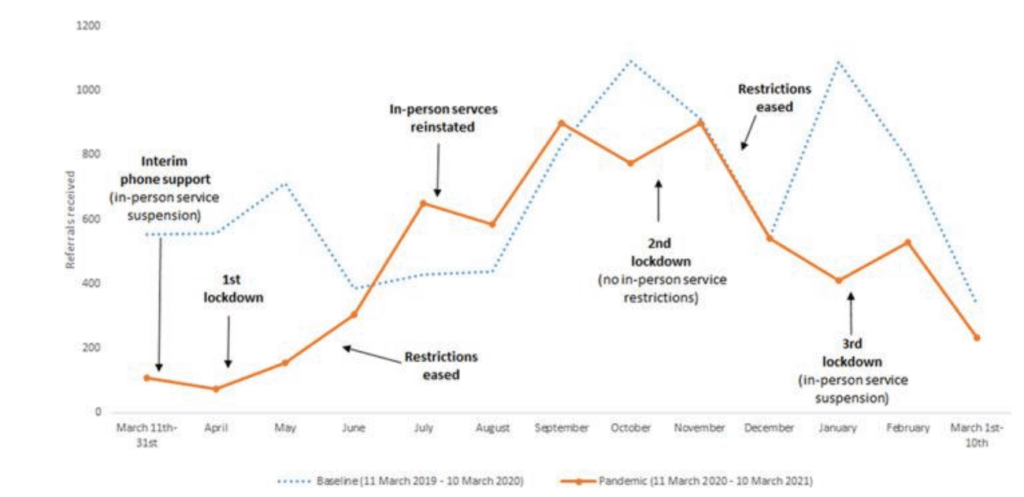
Prior to March 2020, a brief intervention was delivered in‐person by a clinician in a Jigsaw hub. Jigsaw’s in‐
person brief intervention services were suspended from 13th March to 3rd June whilst the infrastructure
required to deliver phone/video sessions was put in place. During this time, interim phone support was
provided to young people who had been engaged with Jigsaw services prior to the pandemic period, which
included brief check‐ins and some level of therapeutic intervention. In‐person brief intervention sessions
recommenced in July 2020.
There were markedly less referrals to Jigsaw between March and June 2020 when services were
suspended, relative to the baseline period. However, by June 2020, referrals started to increase, coinciding
largely with the easing of the first national lockdown. This upward trend in referrals continued until
September 2020. Referral rates began to fall again in January 2021, during the third national lockdown,
and have remained lower than the baseline period in 2021.
Despite concerns about a dramatic increase in presentations to mental health services, there was an
overall decrease in referrals to Jigsaw services during the pandemic period, which is aligned to previous
research from the early pandemic period (Clerici et al., 2020; McAndrew et al., 2020; McIntyre et al., 2020;
Nicholas et al., 2021; Steward et al., 2020; Szmulewicz et al., 2021). An exception to this was the period
between July to September 2020, when national restrictions were eased in Ireland, and referrals were 25%
higher than the same period the previous year.
However, the extent to which this can be attributed to the COVID‐19 pandemic is unclear, as Jigsaw
services have experienced an annual increase in demand of 18% since 2017. It is possible that some young
people opted to access Jigsaw’s new synchronous chat support service during the pandemic. This new
service supported 2362 young people between June 2020 and March 2021, although previous research
has identified this type of service reaches a unique client group who do not seek help or wait longer before
seeking‐support from in‐person mental health support services (Rickwood et al., 2017). Additionally, there
were 344 732 users on Jigsaw’s website and 1333 contacts to Jigsaw’s national helpline during the
pandemic period, indicating a significant cohort of young people required guidance on navigating mental
health difficulties.
Importantly, this paper revealed some differences in the psychosocial characteristics of young people
engaging with Jigsaw’s brief intervention service during the pandemic period. Of note, significantly more
females and adolescents were referred to Jigsaw, which is possibly because females and younger
adolescents are more likely to seek help when they experience problems (Dooley et al., 2019; Dooley &
Fitzgerald, 2012). Furthermore, there was a significantly higher proportion of young people aged 12–17
reporting anxiety as a presenting issue, which may indicate that those who are younger may be slightly
more vulnerable to experience pandemic related anxiety. There was also an increase in sleep changes
during the pandemic year for most groups. Additionally, 12–16 year olds who engaged with Jigsaw’s brief
intervention during the pandemic period were significantly more distressed, although this effect size was
small. Indeed, several studies have reported increased anxiety among young people since the start of the
COVID‐19 pandemic (de Miranda et al., 2020; Jeffery et al., 2021; Nearchou et al., 2020; Pierce et
al., 2020).
Jigsaw responded rapidly and effectively to the COVID‐19 pandemic, and significant efforts were made to
develop the infrastructure required to deliver therapeutic services online. This report demonstrates there
was strong uptake of and satisfaction with both video and phone support, particularly during national
lockdowns, indicating young people found these modes of service delivery acceptable. Overall, the
attendance rate was higher during the pandemic period, with video support having the highest attendance
rate (i.e., 84%). It is anticipated that online modes of delivering supports to young people will continue in
Jigsaw beyond the current pandemic alongside in‐person supports, as the current data illustrate there are
many young people who express a preference for in‐person support when this is possible. This fits with
previous research which has demonstrated the readiness of young people to accept telehealth services, a
lower cancellation rate this mode of support, but also some hesitancy amongst clinician for this mode of
care (Nicholas et al., 2021).
Establishing the infrastructure to provide support to young people remotely did not come without
challenges. As the findings show, wait‐times for a brief intervention in Jigsaw increased slightly during the
pandemic year, as appointments scheduled between March and June 2020 were rescheduled for a later
date, and some young people opted to wait for in‐person appointments when this mode of support was
available.
Additionally, a number of Jigsaw staff were redeployed to support Ireland’s national health service with
COVID‐19 testing and contact tracing, and a national recruitment campaign for clinical staff was delayed by
four months, resulting in depletion of clinical resourcing. Furthermore, a small number of staff were
absent from work due to illness. Service efficiency was also temporarily impacted rolling out the
technology to provide video support, changing processes to gather consent and evaluation data online,
training staff, and reconfiguring buildings to support physical distancing.
Indeed, the response rate for the youth satisfaction survey dropped to 30% during the pandemic period,
and Jigsaw is continuing to explore ways of capturing feedback from young people online. However, all
adjustments were aided greatly by having a pre‐existing electronic case management and evaluation
system and some investment in technology before the pandemic period.
The three most common presenting issues, both at baseline and during the pandemic year, were anxiety,
low mood and sleep changes. While the issues remained the same across periods, there was a higher
overall proportion of young people presenting with anxiety and sleep changes during the pandemic period.
As there were shifts in demographics between the baseline and pandemic period, the presenting issues
were also stratified in age and gender categories.
All groups experienced some increase in anxiety, but this was only statistically significant for females and
males who were under 18. Additionally, all groups except 18–25 year-old males saw significantly higher
proportions of sleep changes during the pandemic. Finally, analysis indicated there was no significant
change in levels of psychological distress reported by 17–25 year olds. Although distress in 12–16 year old
males and females significantly increased, these changes were minimal, and the effect sizes were small.
Conclusion
At Jigsaw, we believe the pandemic disproportionality impacted the mental health of our young people.
As highlighted above, this is supported by national and international research.
The challenge to us all is to continue to support the mental health needs of our young people and, in
looking forward, to ensure the right supports are in place and are adequately supported to be so.
Jigsaw is Ireland’s leading youth mental health charity and is committed to advancing young people’s
mental health and to developing supportive communities by providing a range of early intervention
primary care services and supports across the Republic of Ireland.
Jigsaw currently has 19 physical services in Dublin (x6), Wicklow, Meath, Roscommon, Galway, Offaly,
Limerick, Kerry, Cork, Galway and Donegal; and with the support of a range of public and private funders,
we deliver a range of free mental health services and supports for young people and adults
including: rolling out comprehensive primary and secondary school
programmes (including NEART) aimed at supporting the mental
health and wellbeing of young people by developing a shared
responsibility for mental health across the whole school
community.
- delivering free, one-to-one, therapeutic sessions with young people (aged
12-25) in-person, online, via phone and video
- offering community-based programmes aimed at better informing,
supporting, educating and empowering young people and those
around them, in places where they live, learn, work and play
- undertaking pioneering research and robust evaluation leading to
transformative evidence to support our advocacy efforts
- providing a wide range of online mental health supports, services
and programmes through jigsaw.ie
Appendix 2:
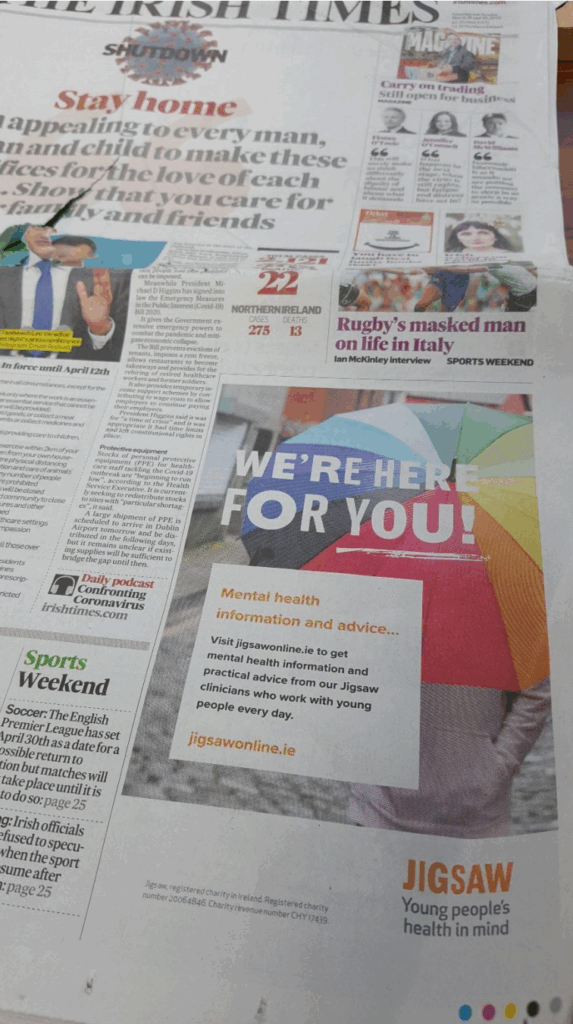
Jigsaw advert featuring on the front page of the Irish Times, the morning after the first national lockdown
was announced on March 19th, 2020.