
Policing and Community Safety Authority
Policing & Community Safety Authority T: (01) 858 90904th Floor E: info@PCSAIreland.ie
90 North King Street www.PCSAIreland.ie
Dublin 7
DO7 N7CV
Ref: PCSA-GC-00300-2025
03 September 2025
Professor Anne Scott
Chair of the COVID-19 Evaluation Panel
16 Parnell Square East
D01 X9Y2
Re: Policing During COVID-19
Dear Professor Scott,
I write in response to the call of the Evaluation Panel for stakeholder submissions
on insights on the pandemic response.
As you will be aware, An Garda Síochána (AGS) played a critical role in the State’s
response to COVID-19, from enforcing the public health restrictions – including
through the use of extraordinary, emergency powers provided to them – to
engaging in significant levels of community engagement and support.
Beyond the direct input of AGS, policing services and the communities they are
provided to were also significantly impacted by the State’s response to the
pandemic. This includes through:
The public health restrictions influencing the working arrangements of AGS
and those of their key statutory and non-statutory partners;
The effective closure, and later constrained capacity, of the training college
in Templemore. It is perhaps interesting to note and draw wider learnings
from the fact that the decisions made in respect of the Garda College
continue to have significant impacts on the resources available to AGS and
likely will ultimately have an extremely sizeable effect on same up to a
decade following the onset of COVID-19; and,
The impacts of rapid societal change on crime, social behaviour/norms, and
victimisation.
In this context, following a request by the then Minister for Justice, the Policing
Authority – the predecessor to the Policing and Community Safety Authority
(PCSA) – provided regular reports to the Minister on oversight of COVID-19
policing. I attach the 16th and final of these reports, which provides an overview of
the oversight undertaken over the period March 2020 to December 2021, and
conclusions drawn. The full suite of reports is available here.
As well as ongoing contact with AGS at both a senior and frontline level, these
reports were informed by extensive engagement by the Policing Authority with a
diverse range of stakeholders, including community groups, and NGOs
representing victims and minority communities.
I and my colleagues are available if you or your officials would find it useful to
engage on the content of this letter, the cited reports, or if any further
information or clarification is required.
Yours sincerely,
Helen Hall
Chief Executive
Report on Policing Performance by the Garda Síochána during the COVID-19 Health Crisis, 10 December 2021
Contents
Chairperson’s Foreword …………………………………………………………………………………………………………… i
Introduction ………………………………………………………………………………………………………………………………………… 1
Key Restrictions and Regulations in Response to COVID-19………………………………… 2
Policing COVID-19 in Numbers ……………………………………………………………………………………….…….. 5
Wellbeing of Garda Members and Staff ………………………………………………………………………… 11
Stakeholder Engagement ………………………………………………………………………………………………………… 13
5.1 Reflections from Authority Outreach …………………………………………………………………….…… 13
5.2 Community Policing ……………………………………………………………………………………………………………… 13
5.3 Community Safety – Complexity of Vulnerability, Need
and the Multifaceted Nature of Solutions ……………………………………………………………………….. 14
5.4 Reflecting on the Status Quo ………………………………………………………………………………..…………. 15
5.5 A Police Service Rather than a Police Force …………………………………………………………… 17
Key Oversight Issues ……………………………………………………………………………………………………………………… 18
6.1 Human Rights and Necessary Restrictions – a Difficult Balance ……………….. 18
6.2 Introduction of Anti-Spit Hoods
for the duration of the COVID-19 pandemic ………………………………………………………………….………. 18
6.3 Agility of the Garda Síochána ………………………………………………………………………………….………. 21
6.4 Recording of the Use of Powers- Transparency and Accountability ………. 22
6.5 The Challenge of Consistency ………………………………………………………………………………….……… 23
6.6 Reaching-in – Domestic Violence and Community
Policing during the Pandemic ……………………………………………………………………………………………………………….. 23
Appendix 1 – Graphical Summary of Certain Policing Activities …………………………. 25
Report on Policing Performance by the Garda Síochána during COVID-19 10 December 2021
Chairperson’s Foreword
There has been a break of some months in the presentation of a further report to the Minister for Justice on
the policing of the health emergency. That reflected the effective lifting of the great majority of the
restrictions on people’s activities and the associated need for emergency policing powers. But the COVID-19
pandemic reveals yet again its capacity to challenge assumptions and to display new and dangerous potential.
Thus, what might have been an end of year reflection has the potential to be another milestone on a journey
that is longer than most have ever contemplated.
It is salutary to recall, as outlined in Section 2 of this report, the rapid changes of regulation, limitation, easing,
reimposition with the inevitable personal impact, pain, tragedy – all reflecting the changing course of the virus.
Nobody was unaffected. Immense challenges faced policy makers, the Health service, the Garda Síochána and,
of course, the entire community. What has been achieved in the last year, in the face of such odds, could
scarcely have been contemplated in early January.
The Garda is much better prepared now, with a much better understanding of what is possible in the event of
any new enforcement requirement. Its members and staff, as the rest of the population, are weary and tired
from the demands of the past two years but the commitment to the delivery of the best possible policing
service is not diminished.
The effectiveness of that service has been a constant theme of these reports, appropriately reflecting the
overwhelmingly positive responses of the public, and of the many organisations who work with various
sections of the public, from the very outset of the COVID-19 crisis. The Garda Síochána had already recognised
the need for a new approach to policing before any new powers were identified or regulations formulated.
That agile, creative and community focussed response has stood the organisation in good stead and has served
the people well.
The foreword to the eleventh report in this series said “The impact of this emergency, ……. will outlast it – in
positive and in challenging ways.” The positive potential has been clear from the beginning. The immediacy of
the response just noted; the engagement with and service to the community, particularly to those who are
vulnerable; the change in tone; all have been well reported in these reports and have been widely
acknowledged and appreciated.
The very early introduction of Operation Faoiseamh was a profoundly important initiative whose value to
those at risk of domestic abuse and whose very positive results have been striking and significant. That was
coupled with the extension of Protective Service units to all Garda Divisions in the state which was, in itself, an
impressive organisational achievement against the background of the pandemic. These will have lasting impact
on the quality of people’s lives and will save, already have saved, lives.
The consolidation of the central importance of community policing has been a further significant outcome
which will give people a greater sense of being safe, secure and supported in the communities where they live.
There is much still to be done in this area of policing but important steps have been taken.
The challenges will also be with us for some time to come. A positive challenge will be to give reality to the
Commissioner’s expressed commitment to capture the experiences of the last two years and to make them a
permanent part of the style and approach of the Garda Síochána’s policing service. But there are also more
demanding challenges.
Side by side with the overwhelmingly positive response of the great majority of people have been the
reflections of those whose experiences of engagement with the Garda Síochána have been less positive, less
encouraging. The voices of organisations who work with communities have been properly and carefully
Report on Policing Performance by the Garda Síochána during COVID-19 10 December 2021
reflected in these reports. And hearing those voices does not detract by one jot or tittle from the positive
achievements that have been recorded. This sixteenth report is no exception save that, perhaps, it reflects a
more sombre note than previously. The views conveyed in Section 5 reflect engagements with more than fifty
organisations across the state and the concerns they express merit careful attention.
They convey the perception of a sense of drift away from the approaches that were so welcome and so
effective in the early months of the pandemic. They suggest an erosion of the emerging more positive
relationship with those for whom relationships with Gardaí had not been good in the past. It has frequently
been suggested in these reports that the very positive response of the public must have been clearly perceived
and appreciated by Garda members on the ground, among the people. It must also be the case that any shift
in the other direction will also be felt by them.
This report raises a number of questions. At heart, they are the questions raised by the community
organisations with whom the Authority has been in contact. And they are the questions that an oversight body
should, and will, properly raise with the Commissioner so as to discern whether the concerns identified are
recognised as authentic and what steps can be, and are being, taken with those communities who feel, to say
the least, at a distance from the Garda Síochána. These qualities of service that characterised the response to
the health emergency did not depend on additional resources or new sources of funding. They were human
responses by professional police officers who recognised the needs of the moment and of the people. Their
place as an enduring aspect of the work of the Garda Síochána will enrich the relationships between Gardaí
and those they serve, will reassure communities that they are valued and will assist the organisation in
broadening the representativeness of its own composition. These are worthwhile benefits to strive to achieve.
This report opens consideration of the issue of force and service. This is an important conversation with which
to engage. The Garda Síochána Act 2005 included an apparently simple but very profound sentence in Section
6 (1) – “The police force called the Garda Síochána continues in being under this Act as a police service.” This
was an important departure from previous statutory usage and reflected a conscious shift by the Government
and the Oireachtas in the perception of the role of the Garda Síochána in Irish life.
Force and service are very different concepts. Force can be used on or against someone; service is rendered to
someone. This difference has considerable significance. The necessary use of force is, thankfully, a very small
part of the policing work of the Garda Síochána. The fact that for a number of years its use is reported
monthly, and soon in increasing detail, testifies to that and is very welcome. Service is a word that much more
closely reflects the nature of policing in this state and that much more closely represents the intentions and
approach of the leadership of the organisation.
And yet, more than sixteen years since that legislative change, the new concept has not been internalised in
the language of policing used within the Garda Síochána, in the Houses of the Oireachtas and certainly not in
the media. Like Homer, even the Policing Authority nods from time to time. This is not a mere semantic point.
It is crucially important and very influential in the way communities and individuals think about the vital role
that policing plays in all our lives. There is a challenge to all with an involvement with policing to pause and
consider the importance of reflecting the statutory foundations of the Garda Síochána in all that is written and
said about it.
Bob Collins
Chairperson
Report on Policing Performance by the Garda Síochána during COVID-19 10 December 2021
Introduction
This is the 16th Report to the Minister for Justice on the Authority’s oversight and assessment of the
policing performance of the Garda Síochána through the COVID-19 emergency.
Back in March 2020, when it became evident that the onset of the pandemic would require a
sweeping range of responses from Government, it was clear to the Authority that greater and
exceptional powers given to the Garda Síochána would require a related and comparable change in
the nature and focus in the oversight of policing.
To achieve this, the oversight framework put in place by the Authority in early 2020, in response to
the extraordinary circumstances then emerging and which continue today, includes:
Placing human rights and ethics at the centre of its oversight;
Timely and frequent engagement with the Garda Commissioner and his senior
colleagues;
Establishing parameters of reporting from the Garda Síochána to ensure that sufficient
information is available to allow for comprehensive oversight;
Weekly and monthly reports on the use of COVID-related powers were required from
and provided by the Garda Síochána to the Authority;1
Discussion at Committee and Authority meetings with the Garda Síochána to ensure
mutual understanding of the challenges, processes, governance and reporting in the
Garda Síochána and for the Authority;
Public meetings to ensure the public has an opportunity to hear and understand the
challenges arising;
Engagement with stakeholders such as statutory bodies, NGOs and civil society to
understand the challenges presented to particular groups and to appreciate their
experience of the policing service at this time; and,
Environmental analysis in terms of crime trends and media trends as they reflect public
concerns.
The Authority can report that since the last COVID-19 report to the Minister submitted in July, in line
with restrictions easing, the level of enforcement activity has continued to fall and the policing focus
is shifting towards contributing to managing the safe reopening of society. With the current rise in
case numbers, waning immunity in the vaccinated population and the emergence of new COVID-19
variants, it is not inconceivable that restrictions to movement and mixing may be reintroduced
which may re-present policing challenges.
Section 2 of this report outlines the key restrictions and regulations introduced as part of the
Government’s response to COVID-19 and its implications for the work of the Garda Síochána. Section
3 provides a brief assessment of the use of powers by the Garda Síochána during the public health
emergency from 8 April 2020 to 27 November 2021 and summarises related data provided by the
Garda Síochána.
Section 4 includes a reflection on Garda workforce wellbeing and the importance of appropriate
supports being provided to Garda Members and staff who often have to work in situations where
social distancing is impossible.
Section 5 reflects on the findings from the Authority’s engagement with stakeholders across the past
21 months, which provides an insight into the nature and consistency of Garda Síochána interactions
during the period. Finally section 6 presents an overview of the key oversight issues, on which the
Authority continues to engage with the Commissioner, the Garda organisation as a whole and with
relevant stakeholders.
2) Key Restrictions and Regulations in Response to COVID-19
Following the arrival of COVID-19 on our shores, emergency legislation was signed into law on 20
March 2020. It is important to remember that this initial emergency legislation provided the Garda2)
Síochána with no additional powers. The approach adopted by the Garda Síochána was to use the
four E’s (engage, explain, encourage and, finally, enforce) with the existing powers of arrest or
caution where necessary, with public health advice asking residents to stay at home and leave home
only for essential shopping or for exercise within two kilometres of their home in order to prevent
the spread of a new and deadly contagion. A contingency roster that saw changes to shift patterns in
the Garda Síochána was introduced on a temporary basis. On 1 April 2020, Operation Faoiseamh
was launched to support and assist the victims of domestic abuse, and continues to date.
On 8 April 2020, in S.I. 121 of 2020, the Minister for Health made the associated COVID-19
Regulations, which granted the Garda Síochána (temporary) additional powers to: (i) direct a person
to comply with the regulations; (ii) arrest them for failure to comply with such a direction; (iii)
request their name and address; (iv) arrest them for failure to comply with the request for name and
address; and ultimately,(v) arrest them for failure to comply with the regulations, if necessary.
Operation Fanacht was launched, using temporary mobile checkpoints and the four E’s to
encourage people to stay home. Lists of allowed exceptions were provided and these lists, and the
end date of the temporary period, were updated and extended before 7 June 2020 to allow essential
services to continue while restricting the public largely to their homes. Figure 1 sets out the launch
of specific Garda Operations related to COVID-19.
Figure 1: Timeline of Garda Operations launched in response to the COVID emergency

On 24 May 2020 passenger locator forms became mandatory for international travellers into the
country, and failure to provide one was made an offence.
On 8 June 2020 S.I. 206 of 2020 came into force, easing some restrictions on movement and
removing the power of arrest for failing to provide a name and address, which led to the scaling back
Report on Policing Performance by the Garda Síochána during COVID-19 10 December 2021
of Operation Fanacht, but also imposing penalties on those organising and attending events and
accessing certain premises. Later in June, all retail outlets were allowed to open, and wearing of face
coverings was advised, but not made mandatory until 11 August. From 29 June 2020 restaurants and
public houses serving a substantial meal, costing €9 or above, were allowed to open with table
service only and specific health and safety procedures in place. This was monitored by the Garda
Síochána through Operation Navigation, which launched on 3 July.
Wearing of face coverings became a legal requirement on public transport in July 2020, although
specific exceptions applied, and this was to be overseen by public transport staff, with the Garda
Síochána called only when a passenger refused to comply with a request or direction of staff.
In August 2020 additional restrictions on movement were introduced in counties Kildare, Laois and
Offaly, which eased after 14 days in Laois and Offaly but lasted 24 days in Kildare, and did not carry
penalties. In late September all public houses outside of Dublin were allowed to open with table
service only and specific health and safety procedures in place, which included a requirement to
record names, contact details and arrival and departure times of patrons, as well as records of
substantial meals served. The Garda Síochána was given additional powers allowing for the
immediate temporary closure of pubs not complying with the conditions. Additional restrictions on
movement (level 3) were in place in Dublin, and subsequently Donegal, and public houses not
serving food were not permitted to reopen in Dublin.
Level 3 restrictions extended countrywide on 7 October 2020, and on 25 October 2020 were
replaced with level 5, which placed general restrictions on movement, with specified exceptions, and
with exercise limited to within 5 kilometres of a person’s home, closed many retail and hospitality
businesses, and further restricted events and gatherings, including house parties. The Garda
Síochána continued to implement Operation Navigation (licensed premises), extended Operation
Fanacht (checkpoints) nationwide and introduced Operation Treoraím, which monitored
compliance in the retail sector. There was no re-introduction of the enforcement powers provided
under the first national lockdown on 8 April but the Garda Síochána continued to use the graduated
approach of engagement, explanation and encouragement, and after 24 November 2020 fines could
be issued in the form of Fixed-Charge Penalty Notices (FCNs) for a range of offences. Such offences
are listed in table 1 on page 6 below. The ability to issue FCNs for COVID-related offences from
mobile devices, carried by roads, community and other Garda members, was rolled out between
December 2020 and February 2021. From 1 December a gradual easing of restrictions allowed all
retail outlets to open, allowed limited gatherings and inter-county travel from 18 to 26 December
2020 (Operation Fanacht was suspended), but restrictions on licensed premises resumed on 24
December, limiting service to take-away only.
In January 2021, level 5+ restrictions were introduced across the country and the levels of
enforcement, as well as COVID-19 case numbers, hospitalisations and deaths peaked in January –
February 2021, as the Delta variant began to take hold. Operation Fanacht was re-launched, with
heavier reliance on static checkpoints. Public houses and non-essential retail outlets were closed and
Operation Treoraím was reinstated, focussing on non-essential retailers opening without
authorisation. In early February 2021, regulations concerning testing and self-quarantine for relevant
international travellers from specified countries were introduced.
On 12 April 2021, S.I. 168 of 2021 introduced the idea of a ‘relevant travel area’ of within county
borders or 20 kilometres of home, as well as pairing of households and different rules for vaccinated
Report on Policing Performance by the Garda Síochána during COVID-19 10 December 2021
and non-vaccinated attendees at gatherings. The Health (Amendment) Act 2021 introduced rules
around mandatory quarantine at designated facilities for travellers from specified jurisdictions and
was supplemented with Statutory Instruments that fixed rates and placed an onus on the traveller to
pay the costs of their stay in the designated facilities. Compliance with quarantine rules was
monitored by the Defence Forces with assistance from the Garda Síochána.
On 11 May 2021, S.I. 217 of 2021 revoked S.I. 168 from April, replacing it with regulations that
maintained the ban on non-essential international travel. While large events in households (such as
house parties) remained prohibited, smaller indoor gatherings involving people from up to three
households were allowed, while gatherings held outdoors could include up to 6 people from any
number of households, or up to 15 people from up to three households. The number of attendees at
weddings and funerals also increased, while sports and training restrictions were eased.
All retail outlets were permitted to open on 17 May as were hotels from 2 June, now permitted to
serve food and drink to overnight guests. Other licensed premises remained closed until later in the
month. During the period between April and August 2021 all adults were invited to be vaccinated,
including Garda members and staff, on the basis of age.
As the number of people vaccinated rose and the incidence of serious illness related to COVID-19
fell, restrictions eased gradually over the summer of 2021, which in turn greatly reduced the number
of situations where FCNs might be issued or Garda powers used. The Garda Síochána had a role in
supporting appropriate staff members in public transport and retail, with the power to issue FCNs
where another outcome was not possible.
In July 2021, EU Digital COVID Certificates were introduced for those who were vaccinated or had
immunity for a specified period. The regulations concerning these certificates contained penalties
for issuing certificates where criteria are not met, forging certificates, or using forgeries, including
fines of up to €4,000 or one month imprisonment. The use of EU Digital COVID Certificates for entry
to the country is enforced by Garda members of the Irish National Immigration Service (INIS), but
the Health Service Executive (HSE) and Health and Safety Authority (HSA) have responsibility for
enforcing the appropriate use of certificates for entry to licensed premises.
On 22 October 2021, Operation Citizen was launched to increase visibility of patrols in Dublin city
centre as restrictions are eased and the night-time economy begins to reopen. The temporary
COVID-19 powers will remain in place until 9 February 2022, with the possible return to stricter
restrictions if the Government deem it necessary. The evolution of the COVID-19 virus and the
response by Government remains fluid. With the increasing incidence of the latest variant of
concern, Omicron, and the possible re-introduction of restrictions, it will remain important to
monitor any renewed implementation of the exceptional powers afforded to the Garda Síochána.
Likewise, in the event that the incidence of COVID-19 begins to decrease and there is a return to the
use of standard policing powers it will be important for the Authority to ensure that there is no
overhang in terms of policy or practice from the use of the current exceptional powers.
Report on Policing Performance by the Garda Síochána during COVID-19 10 December 2021
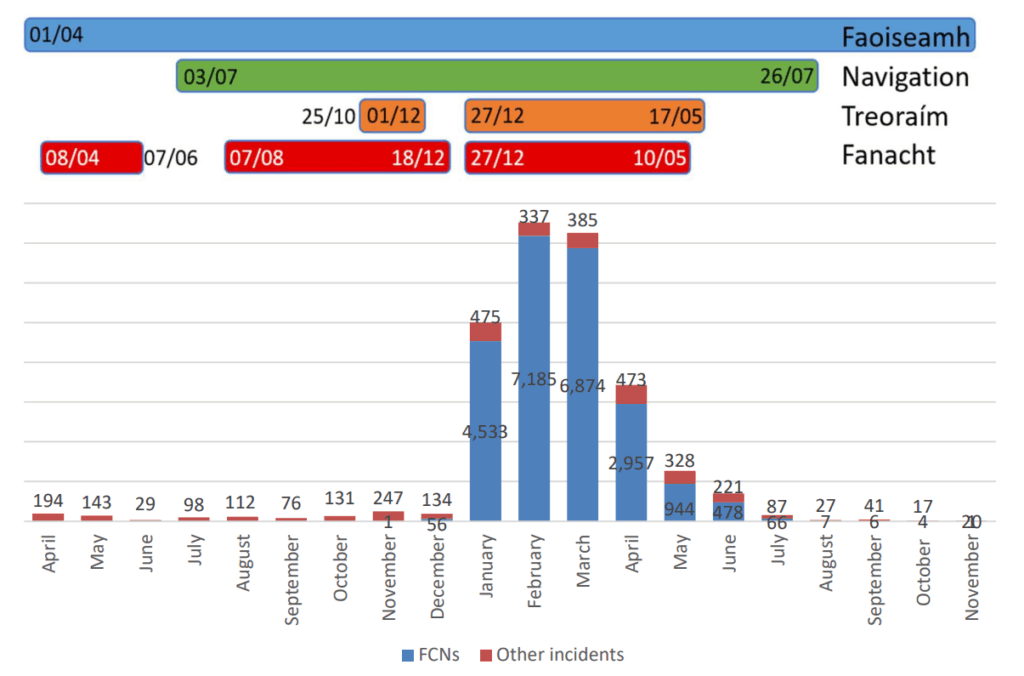
3) Policing COVID-19 in Numbers2
In the period beginning 8 April 2020 up to 29 November 2021, 23,112 FCNs were issued to
individuals for breaches of COVID regulations, representing an increase of 882 since the last report.
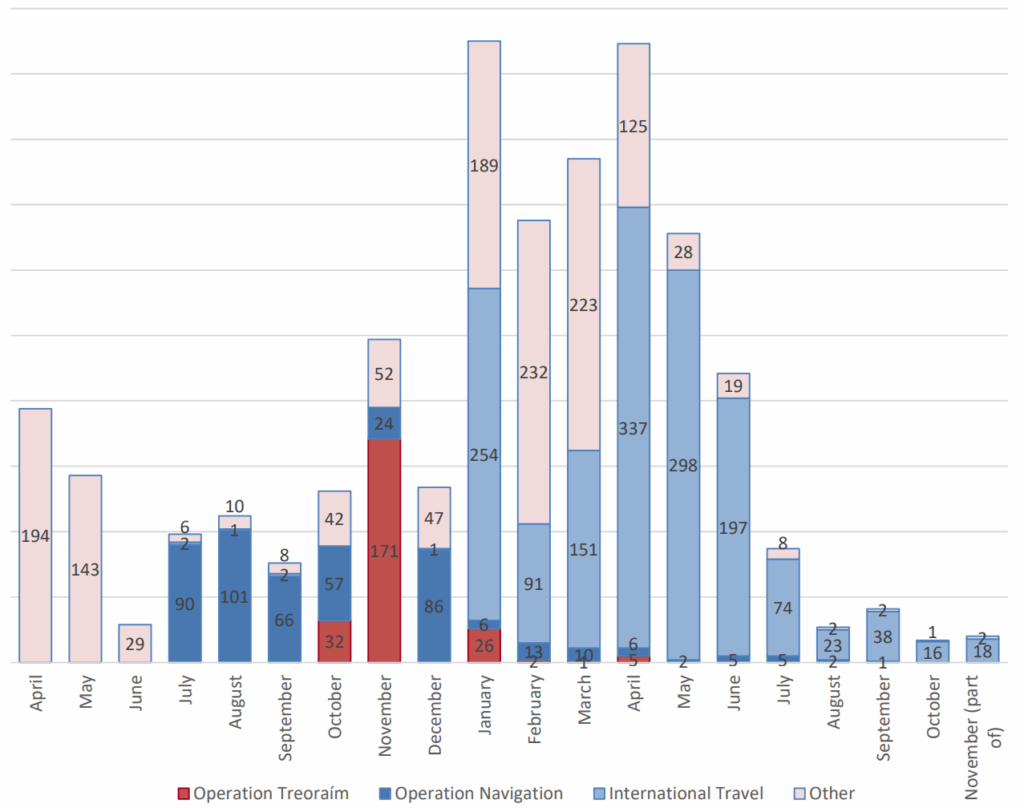
These are presented in greater depth in Section 3.1. In addition to this, there were 2,865 incidents
up to 27 November where COVID-related powers were used by the Garda Síochána that did no
involve FCNs, but may result in charges and/or summonses for individuals. These are outlined in
Section 3.2, along with other data relating to policing during the public health emergency.
Figure 2: Timeline of COVID-related operations and number of incidents where powers under
COVID-19 regulations were used, or fines were issued, 8 April 2020 to 27 November 2021
3.1 COVID Related Fines
Since the last report to the Minister, which covered the period up to 9 July, an additional 882 FCNs
have been reported, bringing the total number of FCNs issued up to 29 November to 23,112.
Although levels of enforcement have fallen sharply as restrictions have eased, a large proportion of
the additional fines imposed have been applied retrospectively to the period before July, and a
number of fines imposed in the first half of the year have now been converted to charges or court
summons, and therefore added to the data presented in section 3.2.
Figure 3: COVID-related fines (FCNs) per week, 20 November 2020 to 24 November 2021.
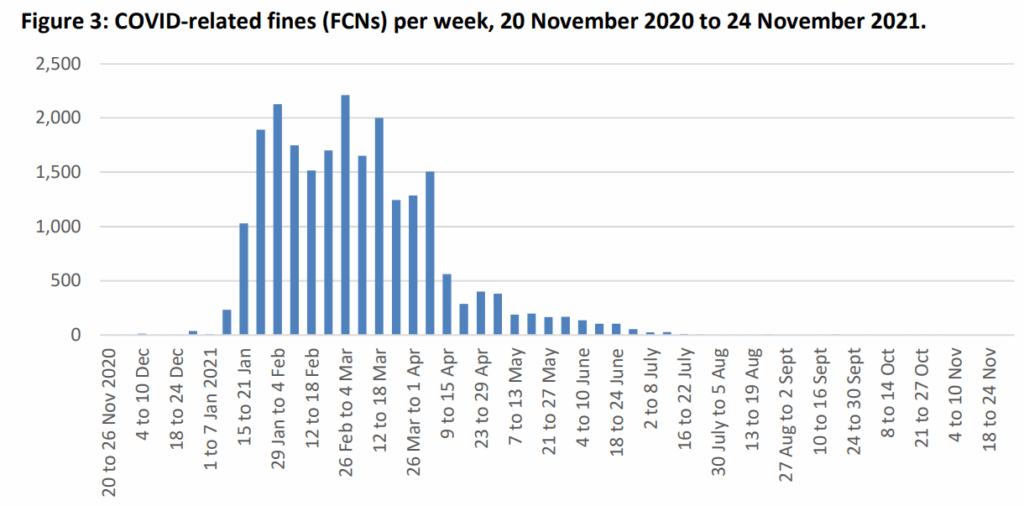
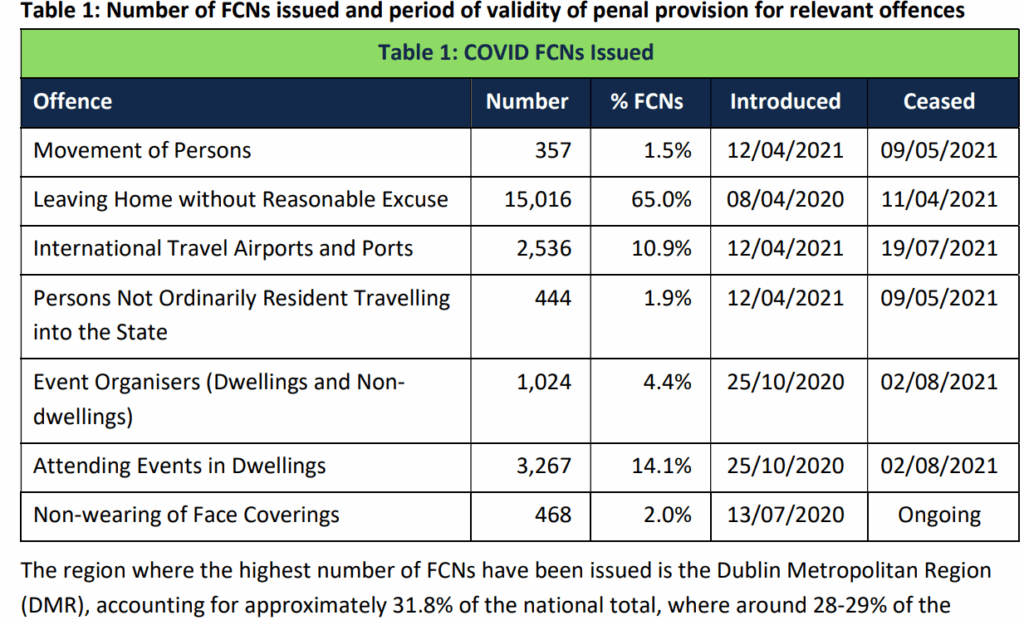
The revocation of domestic travel restrictions has meant that no FCNs have been issued since 10
May 2021 for movement of persons or leaving home without reasonable excuse. The further
revocation of restrictions has also meant that FCNs issued in June or July related only to
international travel, events and non-wearing of face coverings. Since early August FCNs have been
issued only for the non-wearing of face coverings.
The breakdown of offences, for which FCNs have been issued, since their introduction is presented
in Table 1.
Table 1: Number of FCNs issued and period of validity of penal provision for relevant offences
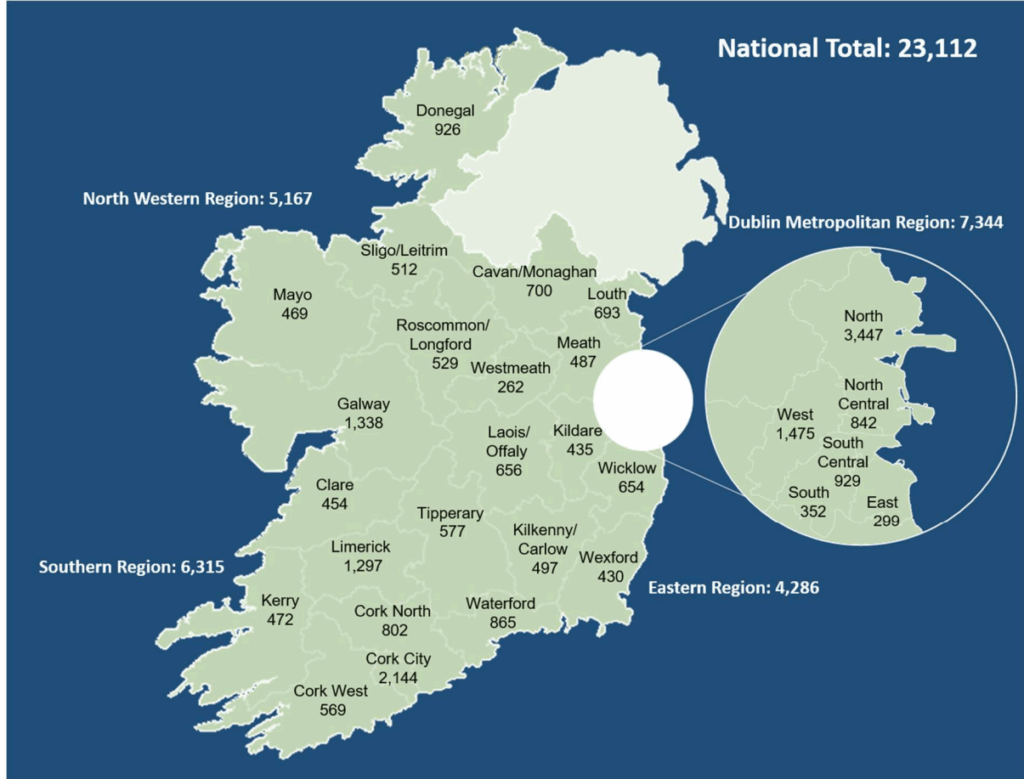
The region where the highest number of FCNs have been issued is the Dublin Metropolitan Region
(DMR), accounting for approximately 31.8% of the national total, where around 28-29% of the
highest number of fines issued, standing at 3,447, 2,144 and 1,475, respectively.
Figure 4: COVID-related fines (FCNs) by Region and Division, 8 April 2020 to 29 November 2021
47% of FCNs issued have been paid to date, while 53% remain unpaid and either have or will result
in court proceedings. In earlier editions of these reports the Authority noted its reservations about
the increasing use of fines, the unfair burden of such fines on the less well-off and the pressures that
the non-payment of fines might place on the Courts system if they are pursued through the Courts.
Overall, 51% of fines were issued to people between 18 and 25 years of age, and the proportion of
fines issued to males is 73%, while 27% were to females. According to the CSO 2020 population
estimate, that group represents approximately 9.9% of the population. Moreover, these figures
suggest that just short of 40% of all FCNs issued were to young men – a group that represents
approximately 4.8% of the population.4
3.2 Non fine-related COVID Policing Activity and Enforcement
In addition to issuing FCNs, members of the Garda Síochána have reported using their powers under
the Health Act, 1947, 2,865 times between 8 April 2020 and 27 November 2021. This is an increase
of 605 on the figure provided in the Authority’s last report to the Minister, in July 2021.
Figure 5: Non fine-related COVID-19 policing in numbers – summary by Region for 8 April 2020 to
27 November 2021 5
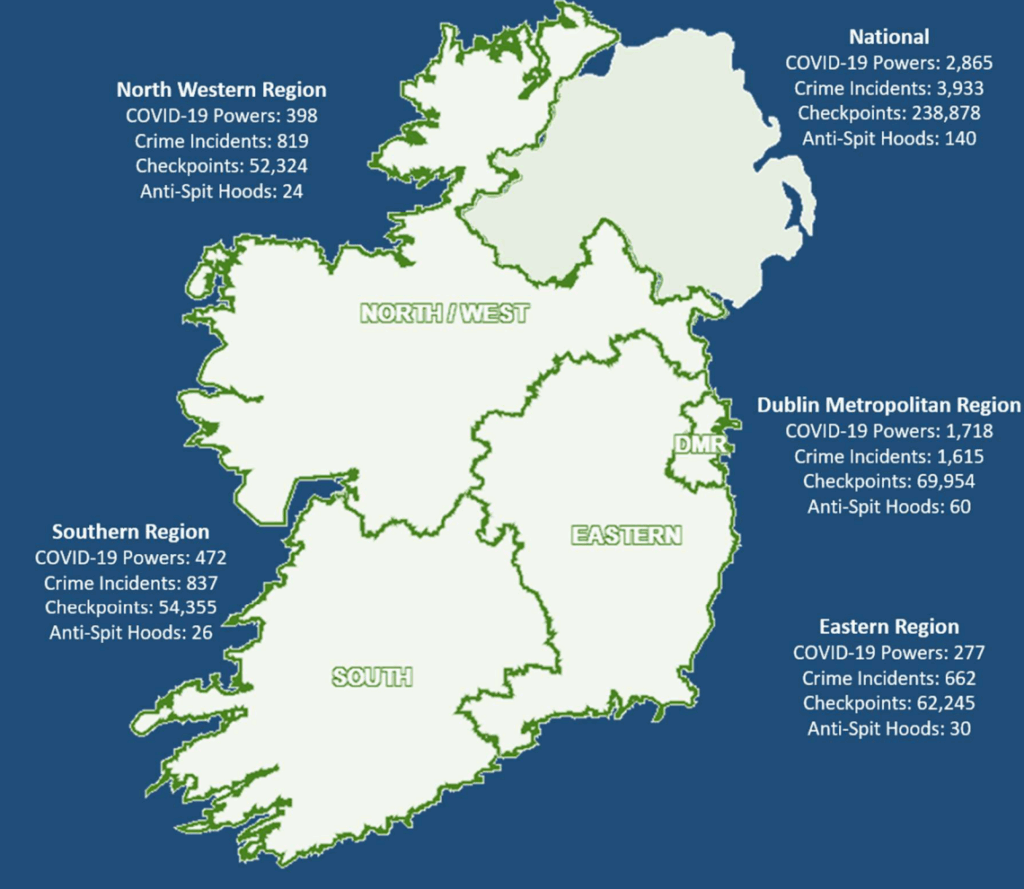
Incidents related to international travel accounted for 1,503 of these. This included 975 incidents
relating to a failure to produce a negative PCR test on arrival into the country, 469 concerning
breaches in mandatory hotel quarantine and 53 related to breaches on mandatory quarantine
outside of designated facilities.
In addition, Operation Navigation, which polices licensed premises, resulted in 474 breaches since
March 2020, while Operation Treoraím, which polices retailers, resulted in 237 breaches discovered.
The remaining 927 incidents relate to other breaches by individuals, including 364 relating to
breaches of travel restrictions in the initial lockdown period and 71 incidents which relate to face
coverings that are in addition to the FCN figures in table 1.
Figure 6: Number of times powers under the COVID-19 Regulations (excluding FCNs) have been
used per month from 8 April 2020 to 27 November 2021
In terms of the geographic distribution of incidents, the largest incidence has been in the Dublin
Metropolitan Region which has reported 1,854 incidents since 8 April 2020. The divisions with the
highest number of incidents over this period are DMR North with 1,316 incidents and DMR North
Central with 229 incidents (see appendix 1, figure 11). The vast majority of new incidents in DMR
North, in particular, have been related to international travel through Dublin airport. Outside of
Dublin, the divisions with the highest number of incidents are Cork City, Galway and Donegal with
195, 164 and 119 incidents, respectively.
From 8 April 2020 to 27 November 2021 there have been 3,933 suspected offences disclosed or
uncovered during the course of COVID-19 policing, representing an increase of 130 incidents since
the last report. There has again been no significant change in the crime types associated with these
incidents, with offences relating to roads, public order and drugs offences being the most frequently
recorded. The regional distribution of these offences is represented in table 2 and in figure 12 of
appendix 1.
DMR, where 28-29% of the population were normally resident in 2020 (see table 2), was where 41%
of crime incidents disclosed in the course of COVID-19 policing were recorded. In the North Western
Region, where 21% of the population reside, 21% of the crime incidents were reported. In the
Southern Region, where 24% of the population are normally resident, 21% of the crime incidents
were recorded, and in the Eastern Region, where 26% of the population resides, 17% of the crimes
discovered during COVID-19 policing were recorded. There has been more crime reported per head
of population in DMR compared to other regions, particularly the Eastern Region that surrounds it. It
is worth noting in this context that the recent analysis of Recorded Crime Detection 2020 by the CSO
showed that overall crime rates in 2020 were higher in most categories in the DMR than other
regions.
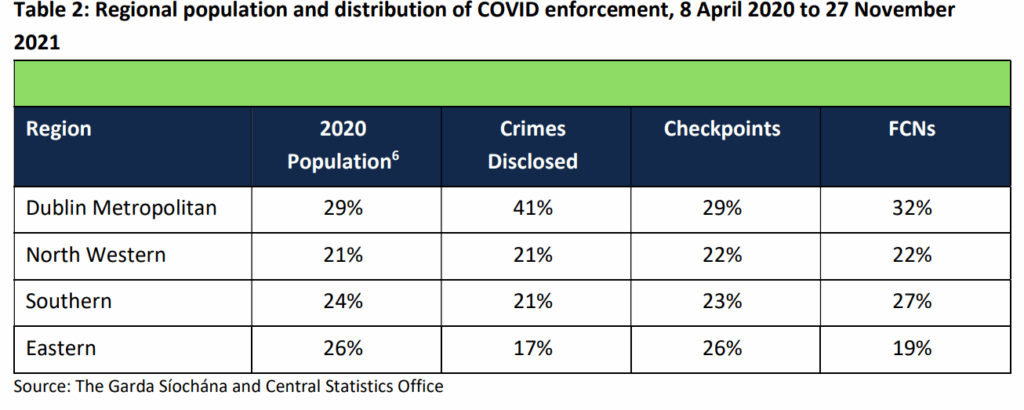
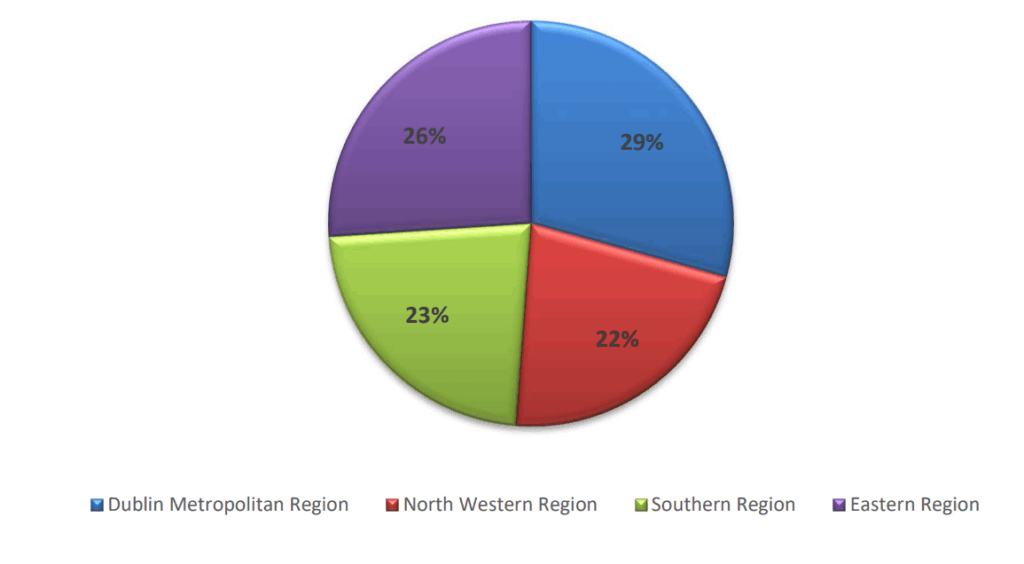
COVID checkpoint activity decreased steadily as restrictions began to ease and no COVID-related
checkpoints have been reported since 11 July 2021. The regional distribution of COVID-related
checkpoints is represented in figure 13 of appendix 1, and closely reflected the population
distribution between the regions, as can be seen in table 2.
4) Wellbeing of Garda Members and Staff
Since early 2020, even before the full extent of the impact that COVID-19 would have on Ireland
could have been projected, the Policing Authority has had a particular focus on the welfare of Garda
personnel, both front line and administrative staff, and on the impact that COVID-19 might have on
resource management. In its first report to the Minister in April 2020, the Authority noted the daily
high-level meetings chaired by a Deputy Commissioner, at which absences and sickness, PPE and the
available resource levels were discussed.
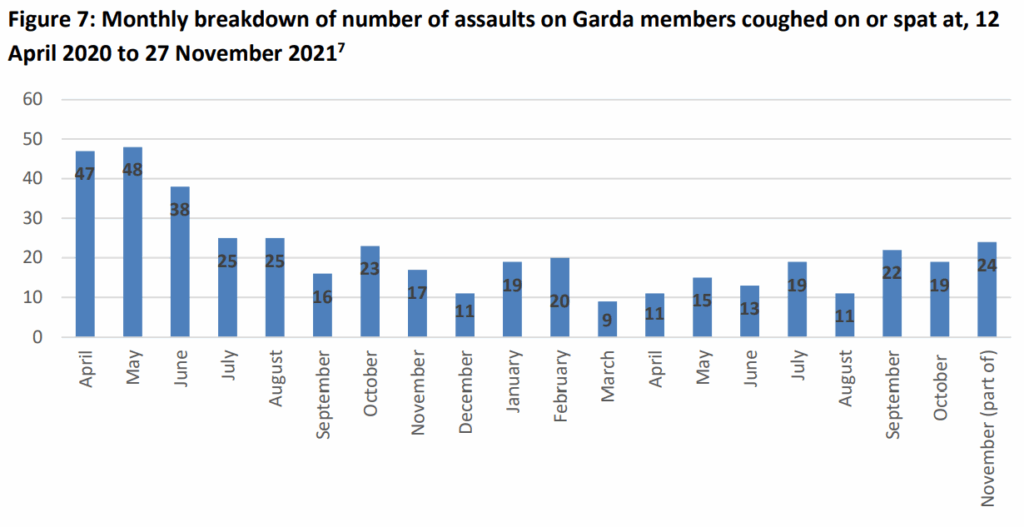
By the nature of their work, Garda members are often at high risk of contracting COVID-19. In
addition they have been subject to physical and verbal assaults from a minority of the public
including the ‘weaponising’ of coughing and spitting. The Authority, like most people, found the
attacks on Garda personnel repugnant and publicly rebuked those who acted in this way. Figure 7
shows that while not at the level of the early stage of the pandemic, there are nevertheless new
spitting incidents reported each month. Since the last report to the Minister there have been an
additional 67 incidents reported, bringing the total up to 432 since reporting began in April last year.
The Authority reiterates its condemnation of any assault on a member or staff of the Garda
Síochána.
The Authority has continued to monitor the Garda Síochána’s actions and initiatives aimed at
protecting the health and wellbeing of its personnel. This has included engagement with members
and staff at all levels of the organisation. In the summer of 2020, members of the Authority
Executive observed COVID-19 roads checkpoints and used this opportunity to speak to members
about their experiences of policing during the pandemic. In spring 2021, in addition to engaging with
stakeholder groups and with senior leadership, the Authority engaged with representative bodies,
held focus groups with divisional officers, attended checkpoints and reached out to probationers to
gather perceptions and experiences of members on the ground while policing during the public
health emergency.
During these and its other regular engagements with the Garda Síochána workforce it has been clear
that despite initial concerns at the early stages of the pandemic, the organisation has placed a
significant emphasis on providing supports to its staff. This has included not only practical measures
to minimise close contacts, provide PPE and have in place adequate cleaning procedures, but also
personal supports in terms of peer support, counselling and employee assistance. Regular
communication of the rapid changes affecting their work, particularly via the award-winning
NewsBeat, kept the workforce up to speed and the internal COVID-19 unit provides a telephone
number for members to call for advice on issues from enforcement to safety. The steps taken by the
Garda Síochána in this regard are welcome.
With the onset of the third wave in late 2020 / early 2021, the organisation was confronted with
multiple challenges that saw resilience levels that had been relatively stable up until then at 94%,
drop at the start of January 2021 to 87%. Around this time, concerns were expressed about the
lower prioritisation of vaccines for Garda members and staff, relative to other services, especially as
coughing and spitting incidents began to increase again in 2021. The Authority wrote to the
Department of Justice on 30 March 2021 supporting the prioritisation of frontline Garda members
and staff in the vaccine rollout. It should also be noted that the significant demands placed on the
organisation to enforce COVID-19 regulations in addition to regular policing was in turn reflected in
increased demands on staff and many members of the workforce did not have a significant break
during the initial year of the pandemic. From the perspective of Divisional Officers, they stressed
that the members, staff and contractors within their divisions went above and beyond during the
most challenging times of the pandemic.
The role the Garda Síochána now plays in the pandemic is very different to the one it initially had.
The majority of emergency powers given to the Garda Síochána have expired with the focus in late
autumn 2021 moving to business and personal responsibility. This move, while freeing members and
staff to return focus to other areas of policing, does not remove the risks to Garda wellbeing. The
Garda Síochána still engage with large numbers of the public and often have to do so in situations
where social distancing is impossible. This, combined with the fact that spitting and coughing attacks
continue to be a feature, highlights the risk that COVID-19 still poses to the Garda Síochána. The
Authority will continue to maintain a watching brief on this matter as the current COVID-19 situation
develops.
5) Stakeholder Engagement
5.1 Reflections from Authority Outreach
The Policing Authority began engaging with communities, organisations and groups nationwide in
late March 2020 to inform its oversight of policing during the health emergency. In line with its
organisational value of listening, the Authority sought out the perspectives of as broad a range of
people as possible to listen to their experience of policing during this time. The response to requests
to engage with the Authority was very positive. Almost every group and organisation approached
availed of the opportunity to talk about policing during COVID-19 and many groups and communities
did so more than once over the past 19 months.
The response is perhaps indicative of the fact that policing matters to most people, even if it is a
service that they may never have cause to engage with outside of passing through a checkpoint or
getting a passport application signed. Most people have views on how effective policing is in a
general sense and also for their communities. Its effective presence can make us feel safe and that
sense of safety allows us to move more easily through the patterns and the immediacy of our daily
lives. It can also help us to feel assured that in the event that we are not safe, there is an effective
service there that will come to our aid. Indeed a strong theme emerging throughout the
conversations has been the need for people to feel safe in order to be able to fully participate in
daily life.
The conversations about policing during COVID-19 were frank and revealed the nature of its
relevance for communities when it works well and when it does not and the Authority is enormously
grateful for the candour and generosity of that engagement. In this report rather than reiterate the
detail of the engagements, which are contained in the previous fifteen reports, an attempt is made
to draw together the key themes that have arisen across the conversations and to identify what
might be the questions and challenges for the Garda Síochána arising from those themes.
5.2 Community Policing
Policing during COVID-19 offered for many a glimpse of a relationship they remember as having
existed in the past between the community and policing. For others it offered a glimpse of what
might be a hoped-for legacy of the pandemic. The conversations with communities offered an
important nuance to a debate around policing that perhaps too often has been oversimplified to one
of Garda numbers. More Garda members were deployed to work in communities, which gave
greater visibility. However, communities in their conversations with the Authority, also spoke about
Garda presence and the distinction was an important one. It was not just that there were more
Gardaí present in the community; but the manner in which they were discharging their duties and
interacting with public, which appeared to have changed.
It was felt that Garda members were accessible and the community felt assured of their interest
during this period. There was a sense of Garda alertness to vulnerability and need and this,
combined with the tone of interactions, appears to have delivered a sense of increased closeness to
the community. For some communities, it felt new to them that Gardaí were present to protect
them rather than to police them. The question was put forward more than once by those spoken to,
as to whether this renewed tone was a product of circumstances, resources, a changed crime
environment, a greater clarity of purpose or perhaps a combination of all of these. Many of those
the Authority spoke with expressed their perception that community policing was not sufficiently
valued within the Garda Síochána organisation for the skilled policing it is and the value it has for the
community when it is effective.
While the circumstances presented by the pandemic were unique, there is a challenge for the Garda
Síochána to assess and understand the factors that enlivened community policing during this period.
There is also a challenge to recognise what constituted presence for communities – what
behaviours, tone and practices were employed by Gardaí that resulted in policing that was valued by
the community.
The conversations over the last 19 months revealed that perceptions of policing are not static, they
are formed, reformed and revised. There is no reason to believe, as the pandemic abates and other
policing needs return to pre-pandemic levels, that the gains made in the relationships with
communities will naturally endure. It is possible that relations will become more challenging.
There is a question as to whether the response of the communities to the tone and character of
policing undertaken during the pandemic is of sufficient value to the Garda Síochána organisation to
merit it considering, and potentially reimagining, its policing presence in the community. This is
particularly pertinent as the Community Policing Framework is currently being rolled out across the
country. If it is of value to the organisation, the challenge for the Garda Síochána may be to move
beyond measuring the success of the Community Policing Framework as simply its roll out and the
deployment of Community Gardaí in the 19 policing divisions.
It may wish to consider incorporating the policing behaviours and practice that it now knows have
value for the community into the framework. These are not necessarily new behaviours and many
Community Gardaí exemplify this approach in their work. But the importance of presence, respect
and tone can be reaffirmed and brought into its own assessment of policing performance – at
individual and organisational level. The question is whether this might allow it to assure itself that
the significant efforts being made are ultimately directed towards delivering the presence and the
sense of safety so evidently valued by communities during this time.
5.3 Community Safety – Complexity of Vulnerability, Need and the Multifaceted Nature of
Solutions
The pandemic created the circumstances in which a great deal of harm could be and was
perpetrated behind closed doors. The restrictions rendered many people increasingly vulnerable. As
first responders with intuitive knowledge of the communities in which they work, the Garda
Síochána found itself reaching in and encountering vulnerability in all its complexity. All those
spoken to acknowledged and lauded the efforts made by the Gardaí, and the agility with which the
Garda Síochána organisation responded to the pandemic. They also pointed to the multifaceted
nature of vulnerability and the complexity of needs and supports that have to be addressed to keep
people safe.
Many of these needs are outside of the remit and competence of the Garda Síochána to resolve on
its own. Organisations spoke to the Authority about how the Garda Síochána positions itself within
those circumstances and the need for that positioning to be increasingly conscious and proactive,
rather than reactive. Organisations cautioned that a solely reactive focus invariably results in the
Garda Síochána ‘filling gaps’ that more appropriately require a non-policing response.
Organisations and groups working in the area of domestic abuse consistently reported a positive
shift in working relationships between themselves and the Garda Síochána during the
implementation of Operation Faoiseamh. On a practical level, this has been about Gardaí working
with organisations and groups, and engaging in joint planning and mutual accountability. For some,
Operation Faoiseamh offered a blueprint for an approach that could be adopted in relation to other
areas of vulnerability and to community safety.
Legislation is currently being developed that contextualises policing as being a significant, but only
one part of what can deliver safety for communities. There is perhaps a challenge for the Garda
Síochána to reflect on the role it played in responding to vulnerability within the community during
the pandemic. That reflection might include how the organisation positioned itself vis à vis other
services. This would include examining the degree to which it leveraged the skills and competence of
other public services, the degree to which it has an understanding of the position it occupies in
relation to vulnerability, and the degree to which skills in collaborative planning and working exist
within the Garda Síochána.
5.4 Reflecting on the Status Quo
Oversight of policing during COVID-19 revealed that while ‘we are all in this together’ and while the
reaction of the great majority was, as reflected in previous reports, overwhelmingly positive, the
reality for many was that there has not been a homogenous experience of either the impact of the
pandemic or of policing during this time. It is not that the new circumstances created new tensions.
Rather the exigencies of the pandemic exposed or exacerbated tensions and difficulties in
relationships with the Garda Síochána that already existed. This was particularly the case in certain
inner-city communities across a number of areas of the country, in Traveller communities; and in the
relationship too between young people and policing, which emerged as an issue that cut across
social class, geography, ethnicity and sexuality.
For some of these communities, policing during the pandemic did little to dissuade them of the view
that they were over-policed but under-protected. For them, the Garda Síochána was not a police
service that was there to serve them and the presence of the police was not a guarantor of being
protected. This resulted in a lack of confidence to report crime. There were exceptions. Early on in
the pandemic the change in tone experienced by some of these communities was highlighted, with
optimism expressed that there could be a positive legacy emerging from the experience of policing
during the pandemic. Interactions were reported as being respectful and communicated a sense
that the Garda Síochána was a police service here to protect everyone. The resilience of that
goodwill appears to have been eroded over time and in the latter stages of 2020 and into 2021,
much of that optimism was gone.
Some of the views heard during this time were that the Garda Síochána was naïve in not realising
the depth of negative feeling towards the Gardaí within these communities. It was not all Gardaí and
particular reference was made to juvenile diversion officers or particular Community Gardaí or
Gardaí working in the area of diversity, whose relationship with the community was of a different
and much more positive character. But the inability to be able to rely on, or have an expectation of
consistency of treatment, service or respect from all members of the police service was strongly
communicated.
There are a number of questions that arise for the Garda Síochána at this time. To what degree is the
Garda Síochána as an organisation satisfied to continue a status quo in which poor relations with
certain communities endure?
The relationship between policing and the Traveller Community is, from what the Authority has
consistently heard from that Community – strained, and the police service is not one on which many
members of Traveller Community believe can be relied on for service or to be treated with respect.
A number of communities in socio-economically deprived areas have articulated a similar
perspective.
The Garda Síochána has undertaken significant work in the area of diversity in recent years. It has a
Diversity and Inclusion Policy, a Diversity Forum and the Code of Ethics that sets non-discrimination
as a standard. The issue in how policing is being experienced in these communities does not derive
from an absence of policy or stated intent that they receive an effective policing service. It derives
from the experience of interactions with some members of the Garda Síochána – the attitude,
language and demeanour of the individual Garda – which erodes the goodwill generated by the
efforts of their colleagues.
Policing during COVID 19 offered a glimpse of what the impact of a change in tone might be for the
relationship between policing and the Traveller Community and the confidence in policing that
might derive from such a change. It is not a resource dependent change but it is potentially a critical
one as it bridges the gap between the stated objectives of its policy and the experience of policing by
this community. Similarly in terms of communities in social-deprived areas, is the organisation
minded to explore and tackle the reasons that these communities believe the Garda Síochána is not
a service that protects them?
In terms of young people there is a strategic imperative for a police service to be alert to their
perceptions of the service it provides. The traditional respect for the police that was perhaps
expected in each generation is no longer assured. Policing now occurs in an age when debates about
global police legitimacy is no longer the stuff of academic musings but rather the content of a young
person’s social media timeline – immediate and accessible. A generation reared in an era
of rightsbased law and expectations of their vindication will need to have their confidence earned.
There is a question as to whether it is enough to recognise unevenness in relations with certain
communities and their lack of confidence in policing or whether it needs to be interrogated to
understand it and to police differently? The other question is what are the implications of not acting
on this?
All of these issues impact policing. They impact the ability of the police service to keep people safe.
They also impact the likelihood that individuals from these communities might contemplate joining
the service, which in turn might limit the realisation of the organisational aspiration that the
composition of the Garda Síochána workforce mirror the society it serves. Arguably addressing the
issue of how these communities experience policing on a daily basis might be a powerful
recruitment tool the organisation could employ.
5.5 A Police Service Rather than a Police Force
It has been striking in the conversations about policing during COVID-19 the significant value placed
on the service provided by the Garda Síochána and the tone of that service. The approach adopted
to the enforcement of restrictions – the ‘4 E’s’ – was in keeping with a police service that enjoys high
levels of trust of the population. In contrast with some other jurisdictions, it was not the might of the
force but the tone and tenor of the service provided, that elicited compliance and reinforced the
legitimacy of the Garda Síochána’s efforts.
This suggests a number of questions. Has the Garda Síochána considered that distinction between
being a police service and a police force? How might that influence how it presents itself to the
community and the nature of the commitments it makes to the community in the Annual Policing
Plan? How does it influence the manner in which it markets policing as a career? What are the
implications, not only for its measures of policing success, but also the things it needs to know about
the service it is providing?
An effective service to the community typically has the characteristics of being accessible to all,
consistent in the service provided and constantly learning and improving based on feedback from
the community it serves. How does the organisation ensure that every facet of its work is predicated
on it providing an effective service and to what degree does it believe it has culturally embodied the
characteristics of a service, in terms of the importance of consistency, accessibility and seeking and
being receptive to feedback on that service?
One of the challenges to responding to these questions is the degree to which the organisation can
be assured that it delivers equitable treatment in the absence of data that reveals the distribution of
its policing activity – its use of force and other intrusive powers and the distribution of complaints
across communities. To what degree do the imperatives for capturing this information still come
from outside the organisation, rather than from a curiosity within the organisation to understand
more fully the quality of the service it provides?
The questions and challenges raised above arise from engagement with over 50 organisations,
communities and groups. As detailed in the previous reports the outcomes of that engagement has
been overwhelmingly positive in terms of the policing service provided during the pandemic. The
identification of these issues in no way diminishes the recognition and value of that effort. But this
period is also an opportunity to reflect on what has been an intense experience for policing, and of
policing, and what might be a positive legacy emerging from that experience.
Key Oversight Issues
6.1 Human Rights and Necessary Restrictions – a Difficult Balance
Through its oversight activities and engagement with the Commissioner and the Senior Management
of the Garda Síochána the Authority continually emphasised the need for the Garda Síochána to
respect the human rights of those it is policing while exercising the new powers afforded to it during
the COVID-19 emergency.
The State has an obligation to protect the human rights of its people, the most fundamental of
which is the right to life. During the COVID-19 emergency this has been used as the main justification
for restricting the freedoms normally enjoyed by ordinary people such as the rights to movement, to
assemble and to protest. While accepting that achieving the correct balance is a difficult challenge
the Authority in its submission to the Joint Oireachtas Committee on Justice8
noted that the last time we faced a pandemic of this magnitude and ubiquity, the political, social
and regulatory
infrastructure of this State was not even in place and the development of thinking on human rights
was in its infancy. It is therefore unsurprising that the Government’s response to ensure the health
and wellbeing of the people through the restrictions imposed, the curtailment of individual
freedoms and the introduction of sweeping new powers to the Garda Síochána would not be
without its challenges.
The ability of the Government to limit rights, however, is not absolute. Restrictions of human rights
must be shown to be necessary, legal, proportionate and non-discriminatory. Over the course of the
COVID-19 emergency the Authority’s statutory task, as well as its response to the Minister’s request,
was to provide external, transparent and evidence-led scrutiny of policing to give confidence that
emergency restrictions were being used legally, proportionately and reasonably. Since April 2020,
the Authority has noted and commented on inconsistencies in the policing of demonstrations and
protests such as the Debenham’s workers, Black Lives Matter and anti-COVID-restrictions
demonstrations. At the same time, it acknowledged the difficult position of the Garda Síochána and
deplored the disgraceful attacks on members of the Garda Síochána during the protests on Grafton
Street, Dublin in February 2021. The Authority has reiterated on several occasions that there is an
important distinction to be made between the right to protest and the policing of the protest itself,
the latter of which should comply with human rights standards irrespective of whether the assembly
is “legal” or permissible under COVID-19 regulations.
6.2 Introduction of Anti-Spit Hoods for the duration of the COVID-19 pandemic
The risk of infringement of human rights was brought into sharp focus by the introduction of
antispit hoods by the Garda Síochána in April 2020. The reason for their introduction was explained to
the Authority as a means to prevent the intentional infection of members with COVID-19 and that
their intended use was only for the duration of the pandemic.
The Authority, has been clear from the outset of its opposition to the use of this device and has
repeatedly asked that justification for their use is carefully monitored and regularly reviewed. Given
their impact, the Authority required the Garda Síochána to record in detail and report on each use of
an anti-spit hood and this has been adhered to throughout.
The welfare of Garda members and staff was a key concern for the Authority, which has repeatedly
condemned spitting, the threat of spitting, and all other abuses and assaults carried out on Garda
members by a very small minority of the public throughout the pandemic.
The use of anti-spit hoods throughout the COVID-19 pandemic has been limited and to date there
have been 140 incidents reported to the Authority. This includes only six additional incidents since
the last report. The significant decline in usage is welcomed. An assessment of the figures provided
reveals:
73 of the incidents involved public order offences, while 36 were associated with some form
of assault.
There were no new incidents of use on children since the last report, with seven such
incidents recorded since the introduction of these devices.
120 incidents involved use of the device on men while 20 relate to use on women.
116 involved persons with Irish nationality and the remainder relate to thirteen other
nationalities. There is no data available on the ethnicity of the persons involved.
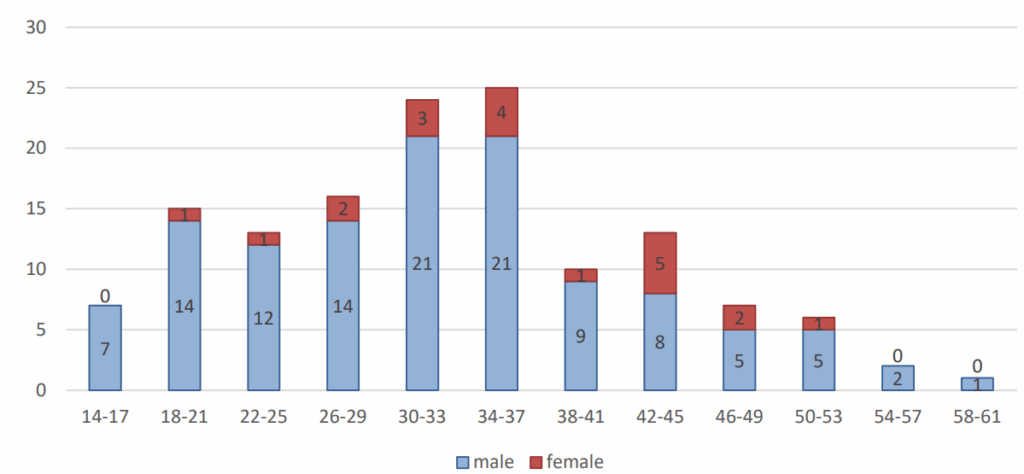
The average age of a person when an anti-spit hood was used on them was 32.6 years, with
over 60% being used on males between 17 and 37 years of age.
Figure 8: Number of applications of anti-spit hoods, by age, 13 April 2020 to 24 September 2021
As mentioned the Garda Síochána committed to reporting to the Authority for every single use and
these reports contain a narrative of events which is assessed against the policy and procedures
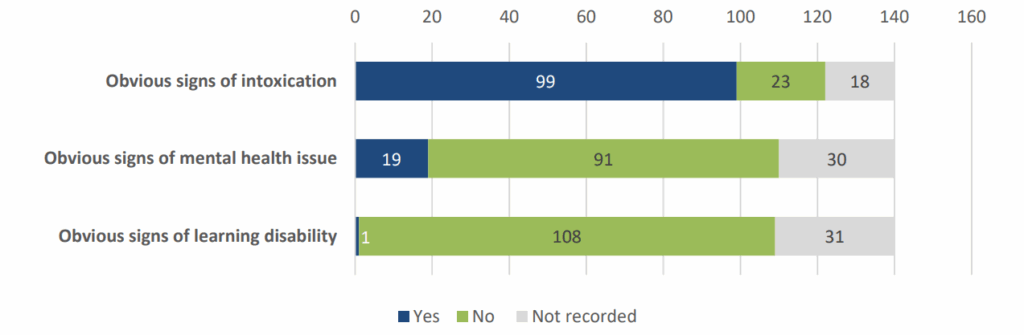
established for using the device. In addition to this, they contain additional data. Analysis of the 140
incidents, for which reports have been received, reveal the following:
In 19 incidents, the Garda member perceived the detainee to have obvious signs of a mental
health issue. This was not the case in 91 incidents and it was unspecified in a further 30
incidents.
In 1 incident, the Garda member perceived the detainee to have obvious signs of a learning
disability. This was not the case in 108 incidents and it was unspecified in a further 31
incidents.
In 99 incidents, the Garda member perceived the detainee to demonstrate obvious signs of
intoxication. This was not the case in 23 incidents and it was unspecified in a further 18
incidents.
Figure 9: Perception of intoxication, mental health issues and learning disabilities in people to
whom anti-spit hoods were applied, 13 April 2020 to 24 September 2021
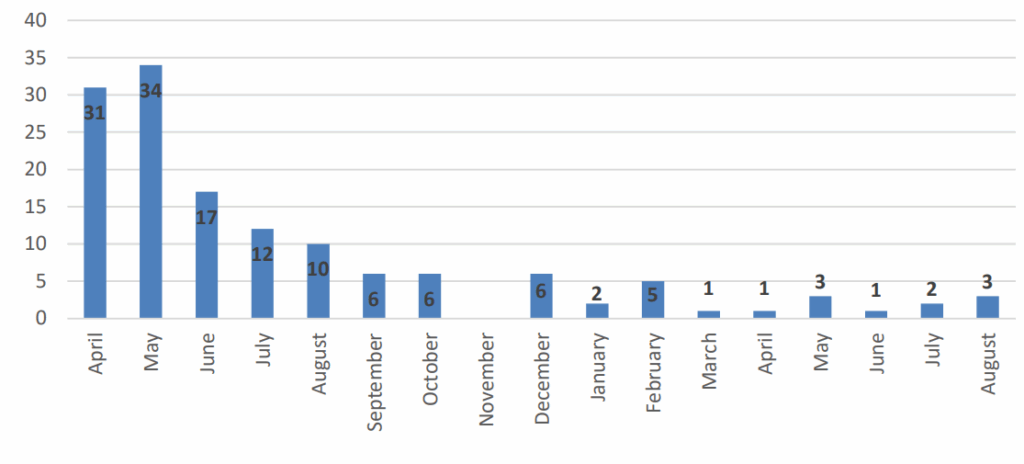
Anti-spit hoods came into use on 13 April 2020 and 31 instances of their use were reported in the 18
days before the end of that month (1.7 per day average). This rate reduced through the months of
May, which saw 34 uses in 31 days (1.1 per day average), and June, which saw 17 uses in 30 days
(0.56 per day average) and stabilised at a lower level at the end of summer 2020. Over the 12
months from September 2020 to August 2021 nationwide total instances of use of anti-spit hoods
have averaged at 3 per month. This is likely to reflect both an appreciation by the Garda Síochána of
the impact of their use and the need to justify that, as well as a response to lower levels of coughing
and spitting attacks, compared to the initial April-May 2020 period (see figure 7).
Figure 10: Number of applications of anti-spit hoods by the Garda Síochána by month, 12 April
2020 to 24 September 2021
An internal review of their management and use was completed by the Garda Síochána in
September 2020. The Authority found that the review did not provide an evidence base for their
retention and was particularly concerned that the approach was to assess how anti-spit hoods could
be used more effectively, rather than considering whether they are necessary or effective.
Furthermore, the review recommended additional content and strengthened governance of training,
as well as revisions to policy and procedures to bring their use in line with human rights advice
provided by the Independent Human Rights Adviser to the Garda Síochána.
The Commissioner subsequently undertook to further review their use and suggested he would
reach a decision by 30 September 2021. This did not extend to a commitment to withdrawing them,
but he spoke of the possibility of a focus on which parts of the organisation would have them
available for use. The outcome of this review is awaited by the Authority.
The Authority has called for a withdrawal of this device, given the lack of evidence as to their
efficacy, one of the principal reasons for their deployment. The Joint Committee on Justice, in its
September 2021 ‘Report on Civil Liberties during the COVID-19 Pandemic’ also noted that “the use
of anti-spit hoods by the Garda Síochána ought to be reviewed, both in the context of policing during
public health emergencies and beyond, due to concerns regarding the implications of their use on
individual human rights and dignities.”
It is the Authority’s view that if there is an intention to extend the use of anti-spit hoods beyond the
duration of the COVID-19 pandemic, this should first be subject to a human rights impact
assessment including public consultation.
6.3 Agility of the Garda Síochána
The extraordinary response of the Garda Síochána to reprioritise activities and redeploy staff, most
notably during the third wave when resources were stretched to the limit, demonstrates the
capacity of the organisation for agility and change.
The Authority has engaged with the Commissioner on this aspect of the organisation’s response and
is encouraging the adoption of the same approach as it implements the various reforms and
organisational changes identified in order to deliver the vision of A Policing Service for the Future.
In addition to the extra workload imposed by COVID-19 and detailed in some of the statistics and
Operations referred to in Section 3, the Garda Síochána continued to deliver, albeit somewhat
curtailed, on the actions set out in the Policing Plans for 2020 and 2021.
Among the significant achievements in 2020/21 was the focus on protecting the vulnerable with the
extension of the network of Divisional Protective Service Units to every Division in the country. This
together with the sustained emphasis over recent years on domestic violence, were the foundations
on which it was possible to construct Operation Faoiseamh.
A fresh approach to crime detection was initiated in 2020 and continues particularly towards
understanding more fully the dynamics that influence or inhibit the successful completion of sexual
violence cases.
There has been a record level of seizures of drugs, currency and assets/proceeds of criminal activity
through work undertaken with national and international partners. Relatedly, a significant increase
in the level of detections of those driving under the influence of drugs has been achieved.
2020/21 also saw the resourcing and formal launch of the Garda Anti-Corruption Unit and the
underpinning of its functions through the ratification and publication of a number of anti-corruption
policies: an overarching Anti-Corruption Policy; the Professional Boundaries and Abuse of Power for
Sexual Gain Policy; and, the Substance Misuse (Controlled Drugs) Policy. This was an early public
commitment of the Commissioner following his taking up his positon and is critically important to
public confidence and trust in the Garda Síochána. Furthermore it was a strong signal to the staff of
the organisation that corruption will not be tolerated and that professional standards underpinned
by the Code of Ethics are important touchstones for members the Garda Síochána.
As well as this, large scale change projects and internal capability were advanced in a number of
areas including: through the continued rollout of the Operating Model; the considerable progress
made in relation to information and technology; the fast-tracked rollout of the mobile devices and
the rollout of the pan-European Schengen Information System.
6.4 Recording of the Use of Powers- Transparency and Accountability
The Authority has consistently held the view that emergency powers for the Garda Síochána should
be as limited as possible and used as sparingly as possible, and has been supportive of the Garda
Síochána employing a balanced and graduated approach to using its emergency powers. The
proportionate use of powers through the graduated approach adopted by the Garda Síochána was
important for public confidence. It is also important for public confidence that the police service is
held to account for its use of these powers.
The Authority has questioned and sought to oversee that the powers are being used consistently
and fairly across the country by the Garda Síochána and has required the organisation to provide
data and information on the use of powers, number of checkpoints, number of fines issued etc.
From Section 3 above it is evident that this data has been collated and provided, requiring a not
inconsiderable amount of effort and analysis by the Garda Síochána’s IT and data analysis staff and
the reporting burden placed on the Garda Information Service Centre (GISC) and the Garda Síochána
Analysis Service (GSAS) is appreciated.
Notwithstanding this there are a number of issues that persist, which the Authority
regards as vital
to ensure transparency, consistency and accountability:
Recording the use of all powers – The Authority highlighted, early on, to the Commissioner a
desire to be able to give a clear indication of the extent to which of the five separate powers
created by the amendment to the 1947 Health Act were exercised by members, and to be
able to offer a view on the extent to which their use was consistent, appropriate and
proportionate. While a lot of data was provided with regard to enforcement and arrest the
Garda Síochána was unable to supply data with regard to those occasions when a Garda
directed a person and that direction was complied with. Such directions must be considered
to be a use of an emergency statutory power but do not appear to be recorded where they
are followed by compliance. The Authority was therefore unable to fully report on the
exercise of the powers as we would have wished, because the necessary information on
which to make such a report and to found such a judgement, was not recorded by the Garda
Síochána;
Ethnic Identifiers – The Authority challenged the Garda Síochána throughout the COVID-19
pandemic to record ethnic indicators for use of powers. This is important to ensure
consistency and equality of policing in all of our communities and ensure policing is
proportionate, fair and in compliance with human rights obligations. The Garda Síochána
were firm in their view that legislation was required to allow collection of such data. Recent
independent advice received by the Authority concurs with the view that legislation is
required to facilitate this recording and this has been brought to the attention of the
Department of Justice.
6.5 The Challenge of Consistency
Complete uniformity, nationally, in the delivery of policing services, given the uniquely peculiar
circumstances that lead to and context within which incidents arise, while aspirational, is not
practicable. This is made more complex by the ability of individual Garda members to exercise their
discretion as required. Nevertheless over the course of the last 18 months, there have been some
striking examples, albeit a relatively small number, of the inconsistent application of powers by the
Garda Síochána across the State. The Authority has spoken with the Commissioner on this precise
issue on several occasions noting that, even with the exceptional circumstances, consistency of
approach is necessary to ensure fairness, compliance with and trust in the Garda Síochána.
Consistency is also required when engaging with the diverse groups and communities that make up
our society. The Authority’s outreach across many diverse communities has elicited a remarkably
positive experience of policing during the emergency. But no set of actions will ever be universally
experienced in precisely the same way. There are communities where the relationship with the
Garda Síochána has not been as would have been wished, and the important aspect of the “tone” of
the engagement has been poor (for example among Travellers, students and young people, in
particular young people of colour). Giving expression to these views, perceptions and experiences is
not to question or negate the experiences of others but to give a richer sense of the differing ways in
which policing can be experienced and perceived. It is necessary that we should appreciate these
differing perspectives, welcome the evidence that the outreach unfolds and value the greater
understanding that will result. The Authority continues to engage with the Commissioner on the
lessons to be learned and has initiated a more detailed programme of work to examine how policing
is experienced across diverse communities.
6.6 Reaching-in – Domestic Violence and Community Policing during the Pandemic
The Authority’s reports on policing during COVID 19 have consistently highlighted the significance
and impact of the manner in which the Garda Síochána reached into communities, perhaps best
exemplified in the work of Operation Faoiseamh. Organisations working with those enduring the
misery and suffering associated with domestic abuse remain overwhelmingly positive towards the
Garda Síochána response to policing of this area of crime through the ongoing implementation of
Operation Faoiseamh. Fears expressed early in the pandemic regarding the likely resilience of the
policing effort in this area have been unwarranted. Our engagement with stakeholders found a
growing sense that the changes in understanding, culture and approach to the policing of domestic
abuse are unlikely to regress. The Divisional Protective Services Units, now present in each Garda
Division, are highly regarded as offering an experienced, expert and victim-centred service to those
who come forward to report. Early outcomes are described as positive and the units are seen to be
working well. Strengthened relationships that have developed between the Garda Síochána and the
groups and organisations working in this area, which had already existed at national level, have
begun to solidify at local level.
The importance of the public statements made by various Gardaí during the period of the pandemic
was again referenced on numerous occasions. These were highlighted as being consistently
victimcentred and clearly offering reassurance that the Gardaí are ‘still here’ and that domestic abuse
against women and men will not be tolerated. It also gave confidence that there is ‘an institutional
understanding’ of domestic abuse and it was remarked that the significance of these moments for
victims should not be underestimated.
Appendix 1 – Graphical Summary of Certain Policing Activities
Figure 11: Reported use of COVID-19 policing powers (excluding FCNs) by Garda Division, 8 April
2020 to 27 November 2021
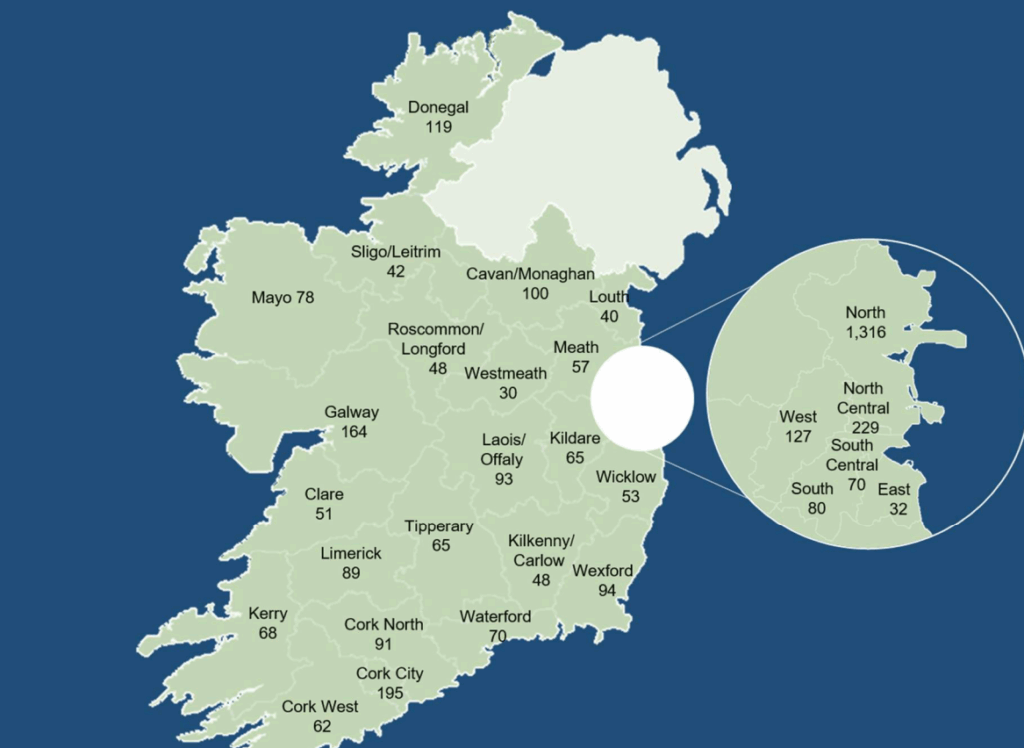
Figure 12: Distribution of crime incidents disclosed during COVID-19 policing activities by region, 8
April, 2020 to 27 November, 2021
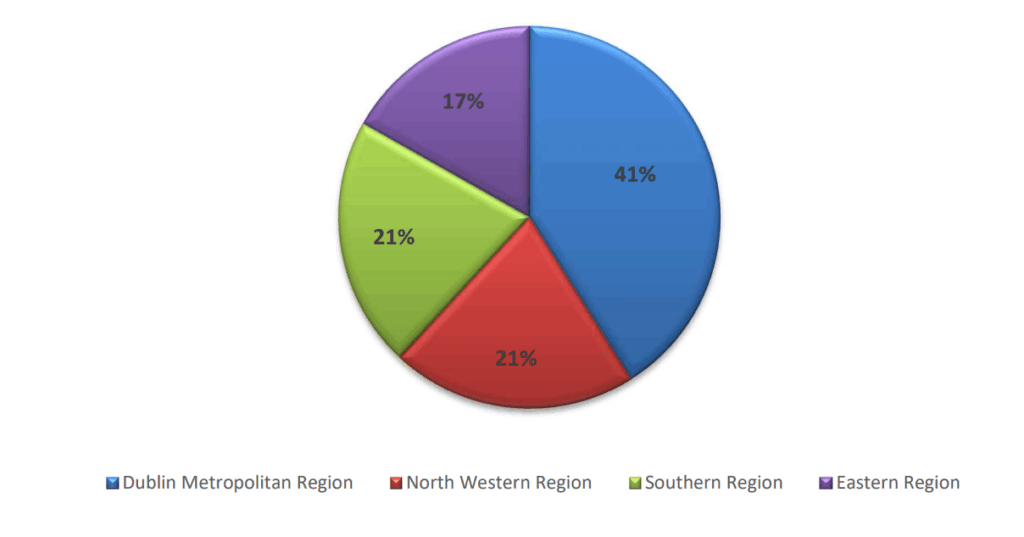
Figure 13: Checkpoints carried out by Region, 11 May to 2 August 2020 and 10 August 2020 to 27
November 2021
Footnotes
1 More recently, as enforcement activity has declined, the Garda Síochána has provided data on request to the Authority.
2 Restrictions were eased on Friday 22 October 2021. FCNs are measured weekly Friday-to-Thursday, so that the reference period is until 29 November, and other crimes are measured Saturday-to-Saturday, so the reference period is until 27 November 2021.
3 Census 2016 figures indicated 28% of population resident in County Dublin, 2020 estimates from the Central Statistics
Office (CSO) indicate that has risen to 29%
4 At the Authority meeting in public on 25 February, the Authority queried the reasoning behind this trend, to which Garda representatives stated that these broadly reflect figures observed in other jurisdictions where fines are issued for breaches
of COVID-19 regulations. 5 Use of COVID powers and crime data refer to 8 April to 27 November 2021. Use of anti-spit hoods refers to 8 April to 23 October 2021. Checkpoints refers to periods 11 May to 2 August 2020 and 10 August 2020 to 27 November 2021. Data are
indicative only.
6 Population of each Garda Region calculated using CSO Population Estimates based on Administrative Data 2020
7 34 of these incidents are on review for clarification.
8 Policing Authority Submission to the Joint Oireachtas Committee on Justice: Balance between the fundamental rights of
citizens and the State’s duty to protect public health during the COVID-19 pandemic, 28 May 2021.
9 According to https://publicpolicy.ie/papers/the-pandemic-one-year-on-trends-and-statistics-between-three-waves-ofthe-covid-19-pandemic-in-ireland/ there have been three waves as follows: Wave 1 (weeks 10-31); 01/03/2020 –
01/08/2020; Wave 2 (week 32-47) 02/08/2020 – 21/11/2020; and Wave 3 (week 48 onwards) 22/11/2020 onwards