Care Alliance Ireland
Introduction
In early March 2020, due to the public safety measures announced by the
Government, families were thrown into a situation whereby respite, day
care, special educational support and other services virtually disappeared
overnight. Not only that, but families which experienced elevated levels of
fear of themselves contracting and indeed spreading Covid19 to their family
members with disabilities, then struggled to access PPE and some had
restrictions placed on access to home care.
Many in the general population, for the first time experienced what life is
like for many family carers and people with certain conditions and
disabilities who had lived with these restricted movements and vulnerability
all the time. Others, who for the first time needed to provide a level of
support to ageing relatives – or someone who was medically vulnerable –
due to cocooning, got a glimpse of what family caring entailed.
Our own organisations’ response to Covid19 was swift. On March 16th,
2020, we pivoted our work, and in collaboration with a number of our
member organisations, former family carers and HSE volunteers, set up a
professionally moderated online support group, which became our core
work and response to the Covid19 pandemic for many months. Five years
one, we continue to coordinate this group and associated online activities
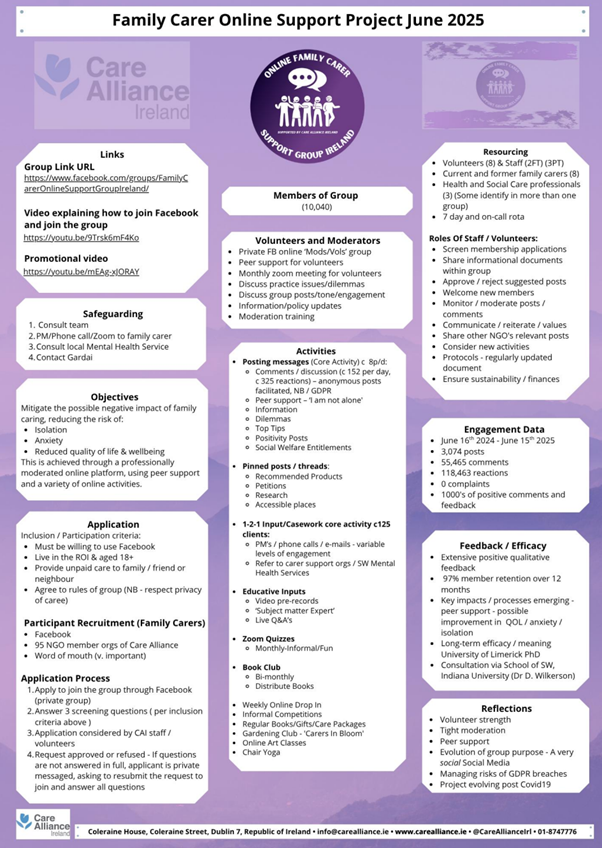
with the welcome financial support of the HSE. As of June 2025, the group
has in excess of 10,000 members.
This submission contains details of our organisational response to Covid19,
and how our organisation has developed into a sectoral and indeed
international leader in online supports for family carers. This is in direct
response to the Covid19 restrictions and challenges experienced during the
Covid19 pandemic, which have been detailed in various pieces of research
(Alzheimer Society of Ireland, 2020; Care Alliance Ireland, 2020; Family
Carers Ireland, 2020; Gallagher and Wetherell, 2020; Inclusion Ireland,
2020; Phillips et al., 2020; The Alzheimer Society of Ireland, 2020).
Online Family Carer Support Group Development
Following the announcement of the initial Covid19 lockdown by An
Taoiseach Leo Varadkar on 12th March 2020, Care Alliance Ireland staff –
namely CEO Liam O’Sullivan and Senior Policy & Research Officer Zoe
Hughes (at the time, the full complement of staff) made the decision to
create an online support group for family carers in Ireland. What was
remarkable about the decision was that, historically, Care Alliance was not
a direct service provider, nor did it have a dedicated social work practitioner
workforce. However, both staff members were fully qualified social workers,
with significant related backgrounds and training as well as relationships
with a network of social service providers, many of whom were
collaborators in family carer advocacy.
In addition, both staff members had significant experience with social
media, particularly the use of Facebook for family carer advocacy.
Beginning in 2007, they worked within their organisation to coordinate
Ireland’s yearly online National Carers Week campaign and in 2012 created
a Facebook page to focus awareness on the event and the work of Irish
family carers. Their online work was also guided by their nonprofit
organisation’s strategic plan, which included the delivery of innovative
online interventions to support family carers.
Based on their experience with social media, they chose Facebook as the
online platform for communications partly because of its widespread use by
adults in Ireland, particularly those within the family caregiver demographic
(Leonard, 2018). In addition, they identified the number of online family
carer support groups operating within the Facebook platform in Ireland at
the time. Only a few private groups were discovered (as access/group
membership was limited to current family carers). This limited the ability
to assess these groups’ operations. However, it was found that the groups
served a limited population that addressed a specific demographic and
health condition, rather than a generic family carer support group, and none
appeared to include a team-based moderation approach. They knew that
team-based moderation, which included a mix of professional (unpaid social
workers) and non-professional (family carer) volunteers, was essential for
a sustainable online support programme. In part, this was because Care
Alliance Ireland, as an organisation, did not have a workforce dedicated to
direct service delivery and because daily and weekend moderation would
be needed to adequately support these family carers.
Initially, a group of six professional social work volunteers were recruited
to moderate the programme. These volunteers were selected based on their
knowledge of caring across the life course of four groups: (1) older adults,
(2) people with dementia, (3) people with mental health support needs,
and (4) children with special needs. Some of them had become limited in
their ability to deliver services through their employment due to the
Covid19 lockdown, making them available to volunteer for this project.
Following a two-month observation period and based on the demands of
daily group moderation and the need for additional mechanisms of social
support, the programme developers recruited six non-professional
moderators. Non-professional moderators were members of the group who
were chosen based on their participation, interaction, and ability to serve
as coping models for other group members.
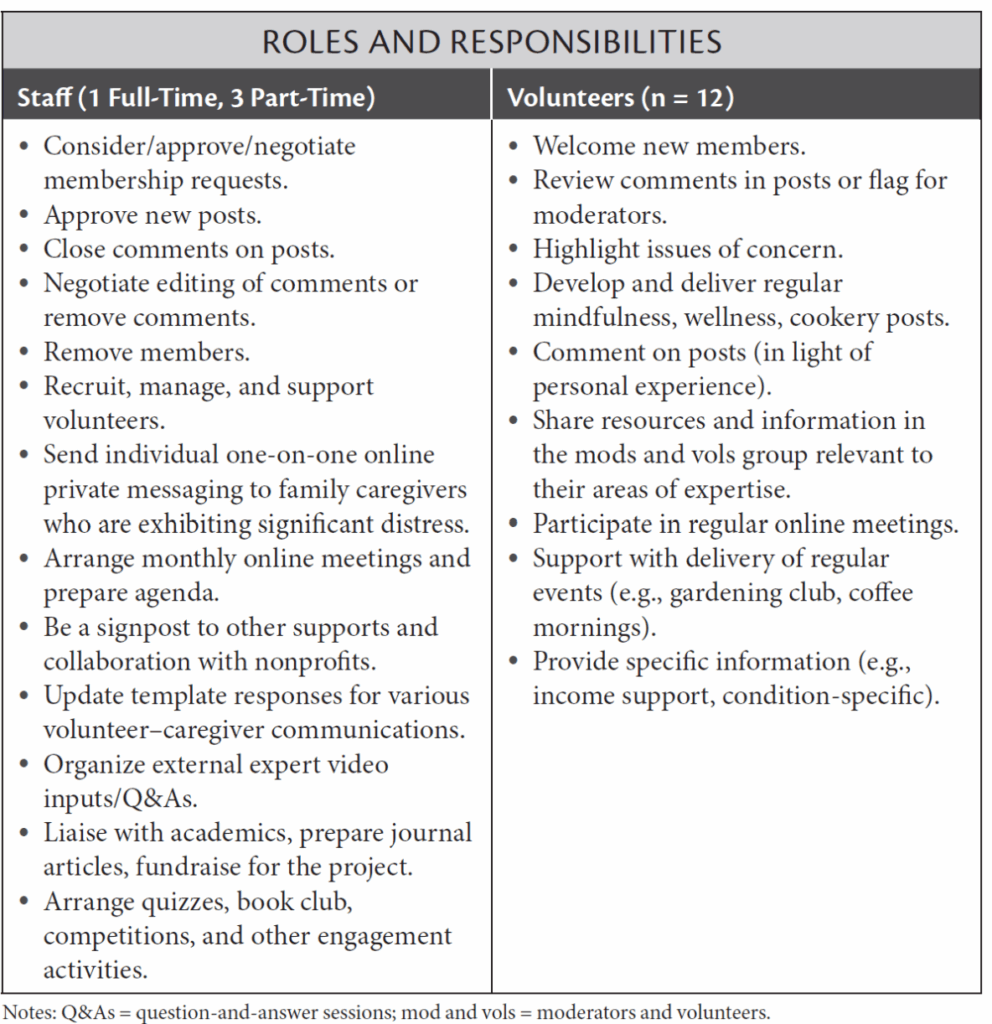
Clear roles and responsibilities were established for programme developers
and volunteer moderators (see table 1). Programme developers were
responsible for creating the programme’s basic architecture; managing
ongoing programme development; and approving, editing, or closing
member posts. Moderators responded to member posts and shared
resources, flagged posts that had content of concern, welcomed new
members, and contributed mindfulness or wellness posts. The moderators’
and volunteers ‘Mods and Vols’ private Facebook group facilitated
collaboration and cloud storage of useful documents, such as suggested
templates for responses, moderator meeting minutes, and moderation
timetables. The moderator team’s communications occurred in
asynchronous and synchronous online spaces. Moderators used the private
‘Mods and Vols’ Facebook group for daily, asynchronous communications
and the Zoom teleconferencing platform for biweekly, synchronous
meetings. These meetings were recorded for those who could not attend.
In order to ensure that the group remained a safe space for family carers,
where they could rely on the veracity of the information given, membership
was restricted as follows
1) Over 18
2) A family carer
3) Living in Ireland
Members did not need to be Irish, but must have been living in Ireland –
this was to ensure that information about lockdowns, health services,
vaccine availability etc., was accurate. Different jurisdictions such as
Northern Ireland and the UK in general had different rules and legislation,
along with vaccine and PPE availability at various points throughout the
pandemic.
Table 1: Moderator & Volunteer Roles & Responsibilities
Over time, the group has evolved into a significant site not just for
information and support from peers, but also for social interactions and fun
for family carers, especially for those carers who cannot travel to access
social supports in person. This is of particular note for those carers for
whom loneliness and isolation are a feature of their caring, regardless of
the impact of Covid19.
Activities
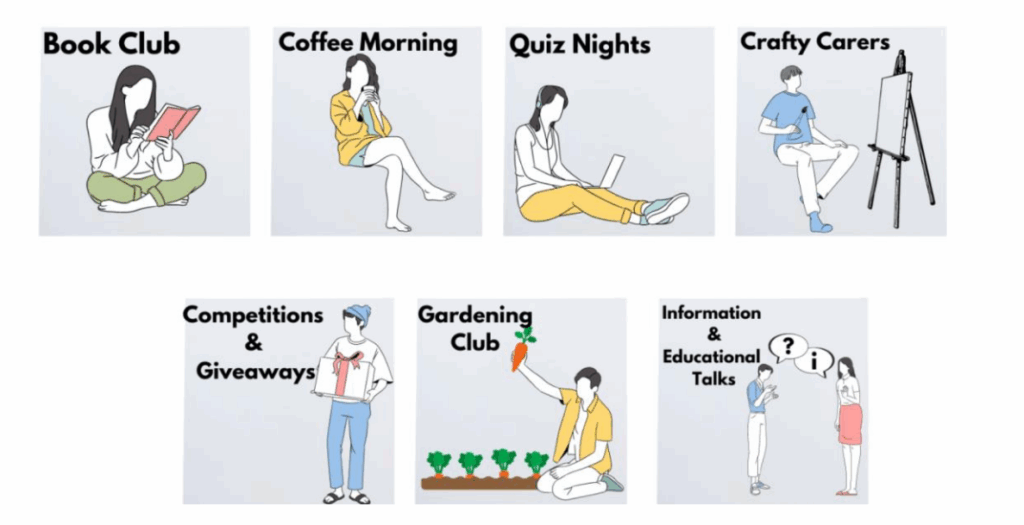
The activities that made up the online family carer support programme
evolved over time. Activity development was based on an ongoing
assessment of need and interest, available resources, and suggestions from
moderators and family carer members. In addition, the four mechanisms
of social support—(a) informational support, (b) emotional support, (c)
tangible support, and (d) appraisal—provided further guidance for
programme developers in their ongoing assessment of family carer needs.
The core activity was the open discussion forum, which moderators
screened for purpose, relevance, value, and adherence to privacy
considerations. It was soon recognised that individuals experiencing
greater distress and reduced coping capacity would benefit from referral to
other services. As such, limited individual case management was provided,
which began with personal messages and moved to emails, phone calls,
and then escalated to referral for individual services available through other
family carer support organisations or mental health agencies.
Monthly quizzes, prepped by the programme developers and moderators
and delivered via Zoom, were next added. These informal, fun activities
were seen to apply the mechanism of emotional support with a focus on
belonging.
A bi-monthly book club was soon added. Interested participants received
copies of one of the books chosen for discussion. Currently, approximately
100 books are mailed to participants bimonthly. Book club discussions,
including the use of virtual breakout rooms, have broadened participants’
common connection of caring. In this way, the book club has become a
vehicle for enhancing emotional support through coping mechanisms of
belonging and self-esteem.
A gardening club was also added to the suite of available programme
activities. The club offered a venue in which members highlighted their
gardening skills, and it provided them with the opportunity to contribute
pictures to its annual calendar. Both the book and gardening clubs also
provided limited tangible support: Moderators mailed more than 1,500 care
packages, hampers, garden seeds or bulbs, and books to family carers over
a period of 24 months. Annual calendars with members nature photos soon
followed.
Feedback from Members
In 2022, we surveyed the members to gain feedback on various aspects of
the group – positives and negatives, individual experiences, etc.
- The gender breakdown of the group members (according to
Facebook) at the time was 94% female, 6% male. The average age
of the family carers who responded is 50. - Respondents are located in every county, in both urban and rural
areas, with more in the bigger cities as would be expected. This tallies
with our Facebook data showing that we have members in every
county in Ireland. - The majority of respondents care for 1 person (64%), with just over
28% caring for 2 people. - 64% of respondents care for a child/stepchild, with 19% caring for a
parent/step-parent/parent–in–law. - The average age of the person being cared for is 36.
- 81% of members have never attended a face-to-face support group.
- 93% of members said their experience of the group was ‘positive’ or
‘very positive’. - 94% of members have found the group helpful to their own situation.
- 96% have never experienced, nor witnessed, any negative
experiences in the group. - Facebook data (97% 12-month retention) demonstrates that family
carers who join remain engaged with the group over time.
Members have been very positive in their written feedback over the
years also: - “This group been fantastic since I joined – really geuine nice people here to hel you in any way they can – best thing I done in a long time for myself joining this group.”
- “The kindness and empathy from the amazing administration is unbelievable. Im so grateful to be a member.”
- “I love that you can get the proper information about carers rights and entitlements and its run very well. I also love the competitions and its so lovely to get something in the post.”
- “Thank you for making me smile on days where it otherwise seemed impossible. Also for making me feel less alone.”
- For the first time I wasn’t on my own. I felt I was part of something bigger. I felt valued and appreciated. I love the Zooms, they give me things to look forward to and the first time I got something in the post (It was from the book club – a book and bar of chocolate) I cried because it was so lovely to get something just because I was a family carer, I was really moved.”
In addition to the in-house evaluation of the project, Care Alliance worked
with a PhD student at the time (Dr. Rosemary Daynes-Kearney) whose
doctoral study was based on the development and efficiency of online family
carer support groups. The findings from her research echoed the earlier
survey: that the group was useful, efficient, and delivered value for money.
It is recommended that this submission be read in tandem with her
publications
(See https://bpspsychub.onlinelibrary.wiley.com/doi/10.1111/bjhp.12764)
Learnings - Online supports for family carers can be effective and reach
heretofore underserved carer populations
o For very limited resourcing, this project has demonstrated to
be effective at counteracting the inherent isolation that family
caring presents.
o Prior to Covid, 81% of members did not engage with face-toface support groups, demonstrating that this project reached and continues to serve an underserved carer population.
o This project is scalable and potentially replicable in other
settings (eg mental health domains). - Policy and Funding developments for online interventions
o In the current Digital for Care Framework 2024-32030 and in
particular the Digital Health Strategic Implementation
Roadmap (Telehealth section), there has been very little
progress made at a macro level in developing online supports,
in spite of our own organisation’s repeated efforts to reach out
to relevant HSE leadership in that area.
o Initial funding for our project did not cover the full costs of
delivering the intervention. Since 2025, thanks to significantly
increased funding from the HSE, the project is now on a more
sustainable financial footing. - Family carers as key to keeping people healthy
o Through Covid19, the role of family carers was partially
recognised, but not fully. The almost exclusive public and media
focus on the work of paid health care professionals was
unfortunate, as in doing so, the contribution of family carers
did not get sufficient attention or recognition. - Family carer isolation is a continuing feature, with or without
o Covid. Further resourcing for home care support and for specific
family carer interventions (through, for example, a fully funded
‘carers guarantee’) is crucial to continue to mitigate the real
risk of social isolation among family carers.
Background Information on Care Alliance Ireland
Our vision is an Ireland in which the role of family carers is fully
recognised and where family carers are adequately supported.
Care Alliance Ireland works to enhance the wellbeing of family
carers so that they are better able to care for their loved ones.
We provide direct support to family carers as well as indirectly
supporting them by working with researchers, statutory actors
and other not-for-profits.
Appendix